Stewardship of Oceanic Futures
Teeming with life and human endeavor, the Blue Pacific is no exception when it comes to the demarcations of Exclusive Economic Zones. These EEZs are the life-sustaining economic arteries of our island nations, the arenas for time-honored concerted conservation efforts, and the testing grounds for humanity's stewardship of marine resources. To truly fathom the stakes within these large-scale marine territories, especially for the many lifestyles of our Pacific Islands, demands a clarity that applies beyond policy rhetoric, listening to the ocean's truthful rhythms and the voices of those who depend upon it.
"not solely paper-based abstract policy debates but daily realities"
Within the EEZs under U.S. jurisdiction, a substantial commitment to marine stewardship is evident, with over 72% of the total U.S. EEZ covered by various fishery conservation areas. These are not uniform designations. They include Ecosystem Conservation Areas, which are specifically designed to provide in situ conservation of biodiversity and cover 56% of the U.S. EEZ. Stringent regulations are in place: For instance, 56% of the entire U.S. EEZ prohibits bottom trawling year-round, a practice often scrutinized for its impact on benthic habitats. An even more comprehensive ban on all bottom-tending gear applies to 37% of these waters. In key areas like the U.S. North Pacific, such conservation measures extend over an impressive 97% of its EEZ, while the Pacific region has 95% coverage. These figures illustrate a proactive, though continually evolving, approach to marine governance, attempting to strike a balance between resource utilization and ecological health.
However, the ocean's currents are no respecters of these human-drawn lines. The Pacific Island Countries and Territories (PICTs), many of whose EEZs greatly exceed their landmass, face an ongoing influx of drifting Poito (Fish Aggregating Devices in Cook Islands Māori and Tahitian) (dFADs) upon their shores. These remnants of fishing operations, often originating far from their eventual stranding sites — sometimes from vessels operating within the convention areas of major tuna commissions like the Inter-American Tropical Tuna Commission (IATTC) and the Western and Central Pacific Fisheries Commission (WCPFC) — pose direct threats through pollution and environmental damage. Close to 4,000 such stranding events have been identified across the Pacific. Buoys alone make up 44% of these incidents, while FADs, whether with or without buoys, account for over 52%. Investigating the origins of these dFADs shows that slightly more are linked to vessels fishing in the IATTC Convention Area (47%) than those in the WCPFC Convention Area (34%), with 19.0% attributed to vessels active in both zones. This highlights the transboundary nature of oceanic health, where activities in one zone can have far-reaching impacts, often affecting vulnerable coastal communities in PICTs.
As global pressures on coastal areas intensify, human enterprise, including the aquaculture sector necessary for future food security, looks further afield, towards offshore and exposed marine environments within EEZs. Now research by Sclodnick and al. shows that this expansion is due for more exact terminology definitions. The term "offshore", often used ambiguously to cover geography, legal status, and technology, requires clearer definition in maritime law. There's a compelling case for distinguishing "offshore" as a measure of distance from the coast, from "exposed", which describes a site's energy conditions based on water depth, current, and wave dynamics. Even the United Nations Convention on the Law of the Sea (UNCLOS), the foundational legal framework for ocean governance, delineates zones such as the territorial sea and the EEZ but currently lacks a precise definition for "offshore" aquaculture. This definitional ambiguity can impede progress. For the engineers developing resilient marine structures, for the biologists choosing suitable species, for the regulators formulating new policies, and for the coastal communities whose futures are linked to these ventures, a universally understood and precise terminology is fundamental. Quantifiable metrics, such as the Specific Exposure Energy (SEE) index, are being developed to provide this needed rigor, aiming to translate the multifaceted energy dynamics of marine sites into a more comprehensible form.
The drive to use EEZs also brings economic and political considerations into sharp focus. A U.S. Presidential Proclamation dated April 17, 2025, indicates a policy shift regarding the Pacific Remote Islands Marine National Monument (PRIMNM). This proclamation is intended to amend previous restrictions to permit appropriately managed commercial fishing by U.S. flagged vessels within certain parts of this large-scale monument, which covers over 400,000 square miles of U.S. EEZ waters. The rationale provided highlights the migratory patterns of species like ʻAhi (tuna in Hawaiian), suggesting that the existing prohibitions had limited effect on conservation while imposing economic disadvantages on U.S. fishermen and territories such as American Sāmoa, where the fishing industry is a cornerstone of the private sector economy, namely through canning activities. This decision illustrates the ongoing dilemma between conservation goals and economic interests within nationally controlled maritime territories.
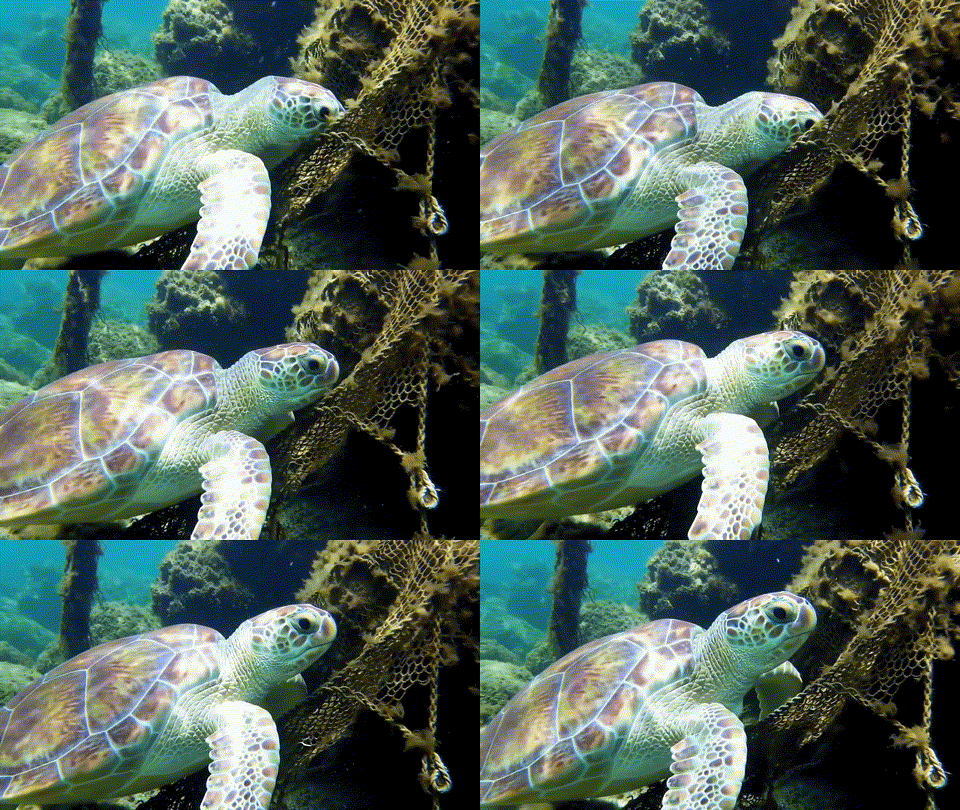
For the nations and territories of the Pacific, these are not solely paper-based abstract policy debates but daily realities. Stranded dFADs frequently appear on their beaches or are collected by local communities. And the environmental cost is significant, including damage to coral reefs and entanglement of marine animals — Fonu and Masimasi particularly (sea turtle and dolphins in Samoan) — and although the latter is less common. This influx of debris directly impacts ecosystems essential for cultural heritage and economic livelihood.
In response to these difficulties, PICTs have shown noteworthy resilience and initiative. Sixteen PICTs, often collaborating with regional organizations like the Pacific Community (SPC) and with backing from non-governmental organizations, have established voluntary programs to gather data on these stranding events. Some of these data collection efforts date back to the 2000s. These programs, which are very reliant on the engagement of local communities who report their findings — often facilitated by fisheries officers — are indispensable for understanding the scale of the problem and for developing informed management strategies. Our teams know quite a bit about such initiatives, since they are conveyed and coordinated using local languages and vernacular, and that they reinforce the irreplaceable merit of culturally sensitive approaches in productive environmental monitoring and stewardship.
The stewardship of Pacific EEZs is an evolving narrative because it reflects the push and pull of ecological imperatives, economic ambitions, the quest for food security, and the assertion of national interests. As marine technologies advance, they enable activities in more exposed and distant waters, and as policies shift to reflect new priorities, these expansive oceanic zones will continue to be areas of intense focus and transformation. The difficulties are manifold, from mitigating pollution, particularly plastics, that respects no maritime boundary to making certain that the benefits derived from these zones are distributed equitably and managed sustainably. Future success hinges on rigorous scientific analysis, adaptable governance structures, and an inclusive dialogue that draws from the full range of stakeholder perspectives.
As global pressures on coastal areas intensify, human enterprise, including the aquaculture sector necessary for future food security, looks further afield, towards offshore and exposed marine environments within EEZs. Now research by Sclodnick and al. shows that this expansion is due for more exact terminology definitions. The term "offshore", often used ambiguously to cover geography, legal status, and technology, requires clearer definition in maritime law. There's a compelling case for distinguishing "offshore" as a measure of distance from the coast, from "exposed", which describes a site's energy conditions based on water depth, current, and wave dynamics. Even the United Nations Convention on the Law of the Sea (UNCLOS), the foundational legal framework for ocean governance, delineates zones such as the territorial sea and the EEZ but currently lacks a precise definition for "offshore" aquaculture. This definitional ambiguity can impede progress. For the engineers developing resilient marine structures, for the biologists choosing suitable species, for the regulators formulating new policies, and for the coastal communities whose futures are linked to these ventures, a universally understood and precise terminology is fundamental. Quantifiable metrics, such as the Specific Exposure Energy (SEE) index, are being developed to provide this needed rigor, aiming to translate the multifaceted energy dynamics of marine sites into a more comprehensible form.
The drive to use EEZs also brings economic and political considerations into sharp focus. A U.S. Presidential Proclamation dated April 17, 2025, indicates a policy shift regarding the Pacific Remote Islands Marine National Monument (PRIMNM). This proclamation is intended to amend previous restrictions to permit appropriately managed commercial fishing by U.S. flagged vessels within certain parts of this large-scale monument, which covers over 400,000 square miles of U.S. EEZ waters. The rationale provided highlights the migratory patterns of species like ʻAhi (tuna in Hawaiian), suggesting that the existing prohibitions had limited effect on conservation while imposing economic disadvantages on U.S. fishermen and territories such as American Sāmoa, where the fishing industry is a cornerstone of the private sector economy, namely through canning activities. This decision illustrates the ongoing dilemma between conservation goals and economic interests within nationally controlled maritime territories.
For the nations and territories of the Pacific, these are not solely paper-based abstract policy debates but daily realities. Stranded dFADs frequently appear on their beaches or are collected by local communities. And the environmental cost is significant, including damage to coral reefs and entanglement of marine animals — Fonu and Masimasi particularly (sea turtle and dolphins in Samoan) — and although the latter is less common. This influx of debris directly impacts ecosystems essential for cultural heritage and economic livelihood.
In response to these difficulties, PICTs have shown noteworthy resilience and initiative. Sixteen PICTs, often collaborating with regional organizations like the Pacific Community (SPC) and with backing from non-governmental organizations, have established voluntary programs to gather data on these stranding events. Some of these data collection efforts date back to the 2000s. These programs, which are very reliant on the engagement of local communities who report their findings — often facilitated by fisheries officers — are indispensable for understanding the scale of the problem and for developing informed management strategies. Our teams know quite a bit about such initiatives, since they are conveyed and coordinated using local languages and vernacular, and that they reinforce the irreplaceable merit of culturally sensitive approaches in productive environmental monitoring and stewardship.
The stewardship of Pacific EEZs is an evolving narrative because it reflects the push and pull of ecological imperatives, economic ambitions, the quest for food security, and the assertion of national interests. As marine technologies advance, they enable activities in more exposed and distant waters, and as policies shift to reflect new priorities, these expansive oceanic zones will continue to be areas of intense focus and transformation. The difficulties are manifold, from mitigating pollution, particularly plastics, that respects no maritime boundary to making certain that the benefits derived from these zones are distributed equitably and managed sustainably. Future success hinges on rigorous scientific analysis, adaptable governance structures, and an inclusive dialogue that draws from the full range of stakeholder perspectives.

Huri Translations
Tel. +689 89 205 483
[email protected]
PO BOX 365 Maharepa
98728 Mo'orea
French Polynesia
N°TAHITI 876649


Social