Where Ocean Swells Meet Quantum Leaps
In the lab of modern physics, researchers have documented evidence that a photon can spend a negative amount of time as an atomic excitation when passing through a cloud of atoms. This counterintuitive finding from the University of Toronto team adds to the growing evidence that particles at the quantum level behave in ways that defy classical intuition.
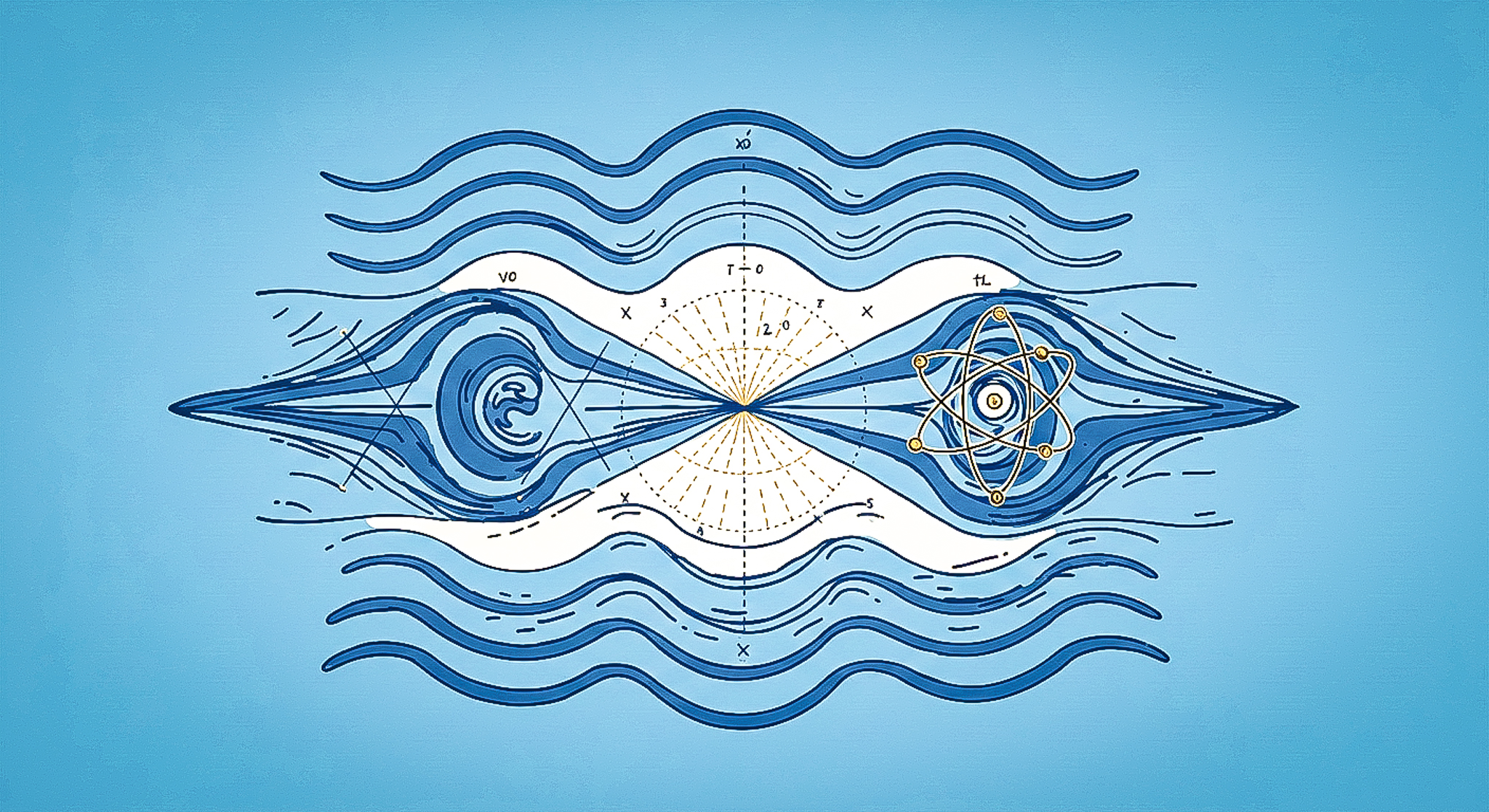
"How might traditional knowledge systems that have recognized relationality for centuries inform our engagement with quantum phenomena?"
When examining different knowledge systems across cultures, we find curious patterns of thought that engage with questions of reality in ways that connect with quantum concepts. Through our translation work with Pacific Island languages, we've ben exposed to conceptual frameworks that approach questions of reality and interconnection in ways that merit consideration alongside contemporary physics.
Negative Time in the Quantum Domain
The Toronto team measured the phase shift imparted on a probe beam by a transmitted photon through an atom cloud. Their findings indicate that when a photon passes through the medium, the atoms excite in a manner proportional to the group delay of the transmitted photon, even when that group delay is negative.
For a photon with a 36 ns duration pulse width at an optical depth of approximately 3, the ratio τT/τ0 (the time atoms spend excited due to a transmitted photon versus an average photon) measured at -0.8 ± 0.2. This negative value suggests that, in a sense, the photon spent a negative amount of time as an atomic excitation.
The researchers explain: "While it is widely known that the group delay can take on negative values, associated with the peak of the transmitted portion of a pulse appearing at times which may indicate superluminal or negative group velocities, it is commonly argued that this quantity does not correspond to the time anything actually 'spends' in the medium."
Yet their observations suggest otherwise. The group delay appears to be "a physically meaningful quantity. It not only provides the location of the center of a transmitted pulse but also correctly describes the magnitude – and sign! – of the effect transmitted photons have on other systems they interact with."
A cornerstone of Western thought has been the firm distinction between observer and observed, mind and material world. This framework posits a detached subject uncovering truths about an independent, pre-existing reality. Quantum physics questions this picture through phenomena like entanglement and measurement influence, suggesting the split between subject and object is not fundamental.*
In quantum physics, the behavior of particles cannot be understood as inherent properties separate from measurement. When physicists like Karen Barad examine the double-slit experiment, they observe that electrons fired one at a time create an interference pattern when both slits are open, as if each electron interferes with itself. The pattern disappears when detectors determine which path the electron takes, which shows that the act of measurement determines the behavior observed.
Barad proposes that reality emerges not from discrete, independent entities interacting, but through "intra-actions" where boundaries between observer and observed are contextually established by the experimental setup itself. What is measured, and indeed what constitutes the 'object' and the 'instrument,' is determined by the specific material arrangement.
This perspective corresponds with many Indigenous worldviews, particularly those of Tangata Moana (Ocean people). Concepts like the Samoan Vā emphasize relational space: The active, connecting intervals between people, objects, land, and cosmos, imbued with reciprocal obligations. This is not an empty void but a space filled with connections that define existence.
Reading Wave Patterns Across Traditions
Traditional Moana navigators have long understood wave pattern analysis, using what Western science would later term "diffraction patterns". Marshallese navigators created charts illustrating how islands create distinctive wave patterns by interrupting ocean currents. When sailing between islands approximately 90NM (nautical miles) apart, skilled navigators could determine their position by perceiving the distinctive rocking patterns of their canoe as it crossed currents.
Masters like Tupaia, the priest, translator and navigator from Raʻiātea who accompanied Cook, possessed extensive knowledge about stars, seasons, winds, and currents. Central to this was understanding Ngaru Whenua: The wave patterns formed as ocean swells interact with emerged or submerged landmass. Navigators could interpret these interference patterns, the subtle textures on the ocean's surface, to locate land beyond the horizon, sometimes from distances exceeding 40NM.
Thomas Young's 1803 drawing of diffractive wave patterns in water bears a correspondence to the Marshallese understanding of currents crossing over in the wake of an island. As Clothier notes in his research on Ngaru Whenua diffraction patterns, this Western scientific understanding of diffraction came centuries after Moana navigators had mapped and used these wave patterns to navigate thousands of nautical miles of open ocean.
In quantum physics, diffraction manifests in the double-slit experiment, where electrons fired one at a time create an interference pattern as if they traversed both slits simultaneously. This wave-particle duality constitutes a cornerstone of quantum understanding, just as the navigation practices of Pacific islanders relied on understanding how islands create wave patterns that can be interpreted by skilled navigators.
Quantum mechanics questions classical notions of a fixed, deterministic reality. Heisenberg's Uncertainty Principle established that certain pairs of properties, like a particle's position and momentum, cannot be simultaneously known with perfect accuracy. Bohr's Complementarity principle and Barad's subsequent development of agential realism take this further, suggesting the issue isn't merely a limit on knowledge (epistemology) but a feature of being (ontology).
Properties aren't just hidden. They are indeterminate until an 'intra-action' within a specific experimental context renders them definite.
This concept of indeterminacy corresponds, albeit distinctly, with concepts found in Buddhist philosophy, particularly the Madhyamaka school articulated by Nāgārjuna, its founder. He employed rigorous logic to argue for śūnyatā (emptiness): The concept that all phenomena, including dharma, the fundamental constituents of reality posited by earlier schools, lack svabhāva (inherent, independent existence).
This concept of indeterminacy corresponds, albeit distinctly, with concepts found in Buddhist philosophy, particularly the Madhyamaka school articulated by Nāgārjuna, its founder. He employed rigorous logic to argue for śūnyatā (emptiness): The concept that all phenomena, including dharma, the fundamental constituents of reality posited by earlier schools, lack svabhāva (inherent, independent existence).
Nāgārjuna questioned whether dharma could exist inherently if they were dependent on causes and conditions. In his analysis, if causality is a conceptual construction rather than a feature of ultimate reality, then dharma cannot exist separately from mind. Through the doctrine of emptiness, he argued that nothing possesses intrinsic essence, not even emptiness itself.
For Nāgārjuna, even emptiness is empty. It's not a new ultimate reality or substrate, it actually serves as a conceptual tool to dismantle attachment to any fixed view, including the view of an ultimate, independent reality. This rejection of a foundational, mind-independent reality corresponds with Barad's rejection of realism based on an observer-independent world.
Their philosophical approaches point towards a reality constructed or emerging through interaction and context, though their methods, motivations (soteriological for Nāgārjuna, ethico-onto-epistemological for Barad), and conclusions differ. Nāgārjuna ultimately directs away from conceptual reality altogether, while Barad aims to establish a robust understanding of our participatory, 'agential' reality.
The Toronto experiment measuring how long a photon spends as an atomic excitation yielded results that question mainstream understanding. For one set of parameters (10 ns pulse duration and optical depth of 4), they found τT/τ0 = 0.54±0.28, which tells us that a transmitted photon spent approximately half as much time as an atomic excitation as the average photon.
However, as pulse duration increased to 36 ns, the ratio became increasingly negative, reaching τT/τ0 = -0.8±0.2. The researchers inquire: "what does it mean for an atom to be excited for a negative time, or, equivalently, for a photon to spend a negative amount of time as an atomic excitation?"
This question finds conceptual parallels in Māori understanding of time expressed in the saying: "Te tōrino haere, whakamua, whakamuri" (At the same time the spiral is going forward, it is also returning). In this conception, time is not strictly linear. Past and future coexist in a spiral relationship that allows for more fluid conceptions than linear causality. And we are not in a black hole yet.
In our translation work with Pacific Island languages, we've found that certain concepts resist direct translation into Western frameworks. The Vā concept or the concept of Whakapapa in Māori tradition contain dimensions that are difficult to translate into western equivalents.
Māori whakapapa traces genealogy through human ancestors but also through connections to land, water, and all life. Reality, in these frameworks, is fundamentally relational, while identity and existence arise from connections, rather than preceding them.
Similarly, quantum concepts like complementarity or wave-particle duality resist expression in classical terms. Physicist Richard Feynman famously stated of the double-slit experiment: "In reality, it contains the only mystery. We cannot make the mystery go away by explaining how it works. We will just tell you how it works."
When translating between knowledge systems, we must acknowledge the limits of direct equivalence and avoid imposing the diversity of traditions into a single mold. Rather than seeking definitive answers or forced equivalences, perhaps the intellectual journey can be experienced in appreciating the diffracted patterns created when different waves of knowledge meet and illuminate the ocean of reality in which we all navigate.
What emerges from placing these perspectives side-by-side is subjective appreciation for the multiplicity of ways reality can be engaged with and construed. The navigational techniques of Moana peoples, validated over vast ocean distances and confirmed by DNA studies showing contact with South America by 1150 CE, give us deep, embodied science rooted in relationality and keen observation of natural patterns.
As to quantum physics, which are born from a different intellectual tradition, uses mathematics and controlled experimentation to investigate the fundamental nature of matter and energy, arriving at conclusions that question its own foundational assumptions about objectivity and separation. Buddhist philosophy offers millennia of contemplative inquiry into the nature of mind and reality, yielding elaborate arguments about interdependence and the limits of conceptualization.
The findings from quantum physics and perspectives from traditions like Madhyamaka Buddhism suggest that we are a part of reality rather than observers. The Toronto experiment is evidence that even light itself interacts with atoms in ways that defy expectations about time and causality.
What could it mean for our understanding if time itself can flow backwards in certain quantum interactions? How might traditional knowledge systems that have recognized relationality for centuries inform our engagement with quantum phenomena? These questions remain open, inviting continued exploration across the streams of consciousness.

Huri Translations
Tel. +689 89 205 483
[email protected]
PO BOX 365 Maharepa
98728 Mo'orea
French Polynesia
N°TAHITI 876649


Social