The Quest for Light: From Fire to Photonics
Humans were not the first to utilize light and fire - birds like hawks learned to capitalize on burned landscapes to catch fleeing prey. Yet no other species has ignited such mastery over light across time.
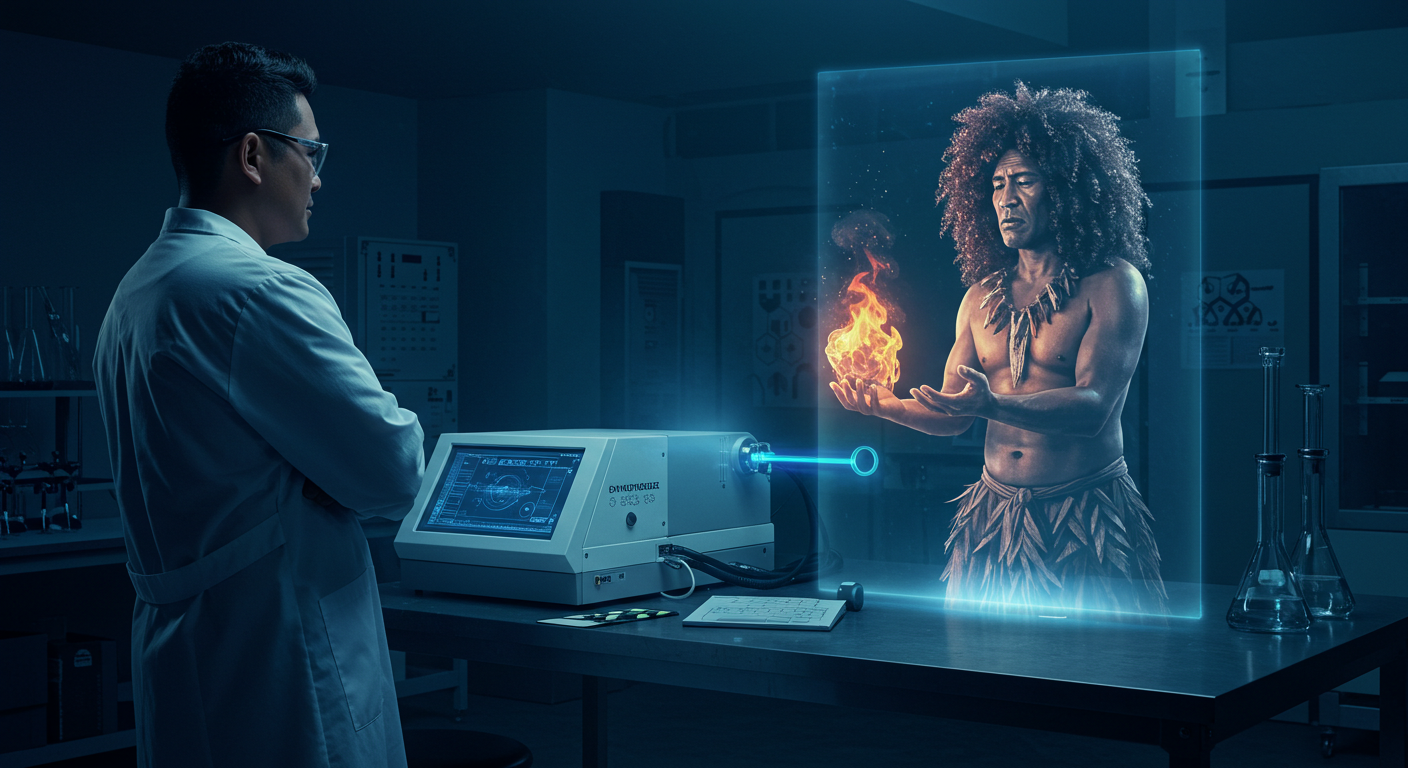
"the drive to master light has shaped human advancement"
The foundational advance came through fire control. Archaeological evidence from East Turkana and Chesowanja in Kenya showcases humanity's earliest known experiments with fire around 1.5 million years ago. As these skills developed, fire extended human activity to 16 hours compared to the 8-hour days of other primates who rise and sleep with the sun.
In the Marquesas Islands, creation myths tell of seven brothers all named Maui. The youngest, Maui Tikitiki, soon outshone his siblings in cunning and daring. Not content with the sun's rapid journey across the sky, which left too little daylight for work, Maui snared the sun with ropes and forced it to slow its path, though not completely halt it.
Other myth variations tell that, as people suffered without fire, Maui determined to obtain it from the underworld. He transformed himself into a pigeon to gain entry to the domain of Mahuika (variants such as Mahuike, Maʻuike, Mafuiʻe, etc.), keeper of fire. Though the fire god resisted with godly might, Maui ultimately prevailed through trickery and incantations.
Fast forward to 2024, where MIT researchers show mastery over light in their own way. Their integrated photonic engine manipulates light beams with precise control. Using thin-film lithium niobate modulators, the system can switch light billions of times per second - a speed that enables control of quantum systems.
The technological leap centers on an innovative architecture. Rather than relying on mechanical mirrors that move slowly, the system uses electrical signals to modulate light, achieving switching speeds up to 7 gigahertz per second. By combining this with reconfigurable beam steering, scientists can direct light to exact locations in three-dimensional space.
Building this system required overcoming significant technical obstacles. The team developed new algorithms to uniformly split light into multiple beams. They also created closed-loop stabilization methods to maintain precise optical control despite environmental changes. These advances make the system practical for real-world applications.
Stories about mastering light and fire blaze through human cultures. In Aotearoa, Māori traditions tell of Maui visiting the fire goddess Mahuika in the underworld. She keeps fire in her fingernails, which Maui convinces her to share one by one. The people of Mangaia, Cook Islands, recount how Maʻuike taught Maui to make fire through friction. In Hawaiʻi, the narrative focuses on careful observation of the ʻalae (Hawaiian Gallinule) to unlock fire's secrets.
Every technological advance in light control brings new capabilities. The MIT system can independently control 16 optical channels, each able to shift light's frequency or amplitude with sub-nanosecond precision. This opens possibilities in quantum computing, imaging, and optical displays.
The archaeological record shows how fire mastery transformed human society: Extending waking hours, enabling cooking, and supporting technological advances from ceramics to metalworking. Today's photonic technologies continue this trajectory, pushing the boundaries of what's possible with light.
Early humans discovered that certain woods like Kaikōmako (Pennantia corymbosa) retained fire's spark. Modern researchers similarly found that the properties of lithium niobate make it ideal for controlling light. In either cases, understanding the characteristics of available materials proved key to advancing light manipulation.
From the first controlled fires to today's integrated photonics, the drive to master light has shaped human advancement. While the tools have evolved from friction sticks to quantum circuits, the core challenge remains: extending human capabilities through increasingly precise control of light and its properties.
The arc of this story, documented in archaeology, mythology, and modern research papers, showcases humanity's persistent efforts to bend light to our will. As we develop more sophisticated optical technologies, we build upon a foundation laid by countless generations of human innovation.

Huri Translations
Tel. +689 89 205 483
[email protected]
PO BOX 365 Maharepa
98728 Mo'orea
French Polynesia
N°TAHITI 876649


Social