The Language Challenge in Air Traffic Control
How do you keep planes safely apart when pilots and controllers stumble over similar-sounding words? In air traffic control centers worldwide, this linguistic challenge plays out thousands of times daily against a backdrop of complex navigation and safety requirements. Recent cases from Indonesia's airspace highlight where aviation safety intersects with the limits of human language.
"ICAO standards require clear procedures for coordination between units and precise phraseology"
Early coordination stands as a key principle in air traffic control. One day, when a Lion Air flight approached Makassar's control area, the controller instructed the aircraft to proceed to a navigation point called LASEM. The pilot read back "LASER" instead. This small variation triggered a series of clarifications, consuming precious radio time and controller attention.
The International Civil Aviation Organization (ICAO) has established detailed standards for air traffic communication. These include requirements for continuous two-way contact between controllers and aircraft, recording of all exchanges, and clear procedures for coordination between different control units. However, these technical standards meet an unexpected challenge in the form of language itself.
At issue is the system of waypoints: Geographic coordinates that help define air routes. ICAO requires each waypoint to have a unique five-letter name within a 1,000-kilometer radius. In practice, this means hundreds of artificial words like PROGO, LASEM, and TAVIP that guide aircraft through Indonesia's skies alone.
The International Civil Aviation Organization (ICAO) has established detailed standards for air traffic communication. These include requirements for continuous two-way contact between controllers and aircraft, recording of all exchanges, and clear procedures for coordination between different control units. However, these technical standards meet an unexpected challenge in the form of language itself.
At issue is the system of waypoints: Geographic coordinates that help define air routes. ICAO requires each waypoint to have a unique five-letter name within a 1,000-kilometer radius. In practice, this means hundreds of artificial words like PROGO, LASEM, and TAVIP that guide aircraft through Indonesia's skies alone.
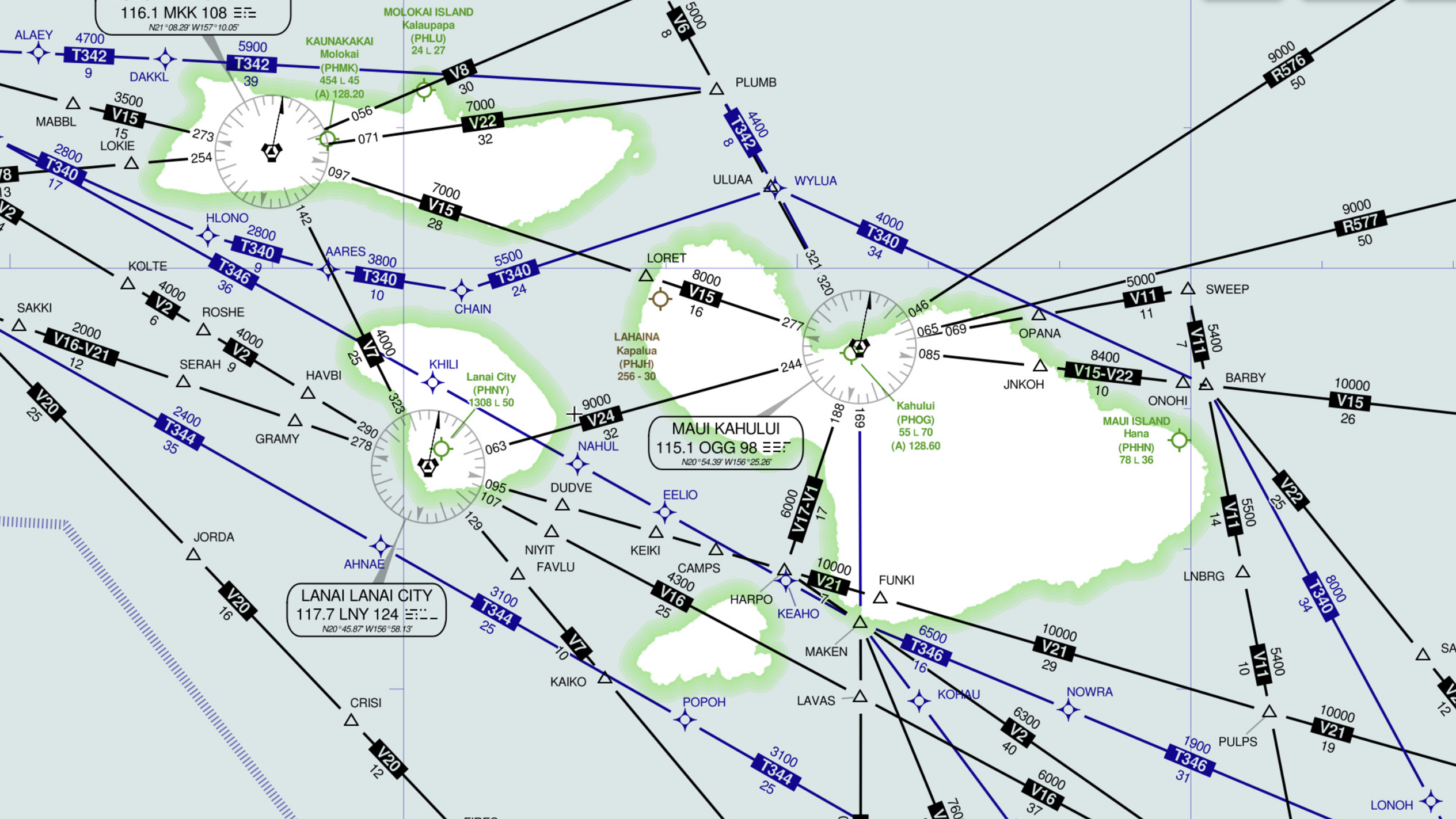
Even in the FAA-controlled airspace, similar issues arise. In Hawaiʻi, controllers deal with waypoint names like HLONO and LONOH: A wink at Hawaiian mythology with God Lono (God of weather and agriculture). The names are separated by just a syllable's difference despite the two waypoints being less than 100 nautical miles apart. These inversions of the same letters create particular challenges when read or uttered.
International standards specify that air traffic controllers must maintain separation between aircraft, coordinate movements precisely, and provide essential flight information. Yet similar-sounding waypoint names can compromise these functions. Research at Makassar Air Traffic Service Center documented cases where pairs of names like KURUS/TIRUS and KADAR/KADAP created confusion in routine communications.
The challenge reflects both regulatory and linguistic realities. ICAO mandates that controllers speak and understand the languages used for radiotelephony. English serves as the international standard. However, when non-native English speakers must distinguish between similar artificial words, the risk of misunderstanding increases.
Air traffic control units have developed various solutions. ICAO standards require clear procedures for coordination between units and precise phraseology for all communications. Some facilities now spell out problematic waypoints using the aviation phonetic alphabet. Others have proposed revised naming conventions that consider linguistic patterns.
The implications extend beyond single facilities. ICAO standards emphasize that air traffic services must maintain safe, orderly, and expeditious flow of air traffic. Communication problems can ripple through the system. When pilots request clarification of waypoint names, it increases radio congestion. Controllers must then balance communication clarity against traffic management needs.
These challenges intersect with ICAO's requirements for air traffic service coordination. Adjacent control centers need accurate position reports and precise coordination of handoffs between sectors. Similar-sounding waypoint names can complicate this process, especially across language boundaries.
Moving forward, aviation authorities face pressure to integrate linguistic considerations into technical standards. This could mean analyzing how different letter combinations affect comprehension across languages or developing new protocols for problematic waypoint names.
The core challenge remains bridging the gap between formal aviation standards and the realities of human communication. As traffic volumes grow, the aviation system must balance the need for standardization against the limitations of language itself.
The experience at Makassar shows how operational requirements and linguistic challenges shape daily air traffic operations. Controllers continue their careful spelling of waypoint names - one more layer of precision in a system where clarity saves lives.

Huri Translations
Tel. +689 89 205 483
[email protected]
PO BOX 365 Maharepa
98728 Mo'orea
French Polynesia
N°TAHITI 876649


Social