Post-Colonial Salsa: Is that a Step Forward or a Skipped Beat?
So, you thought decolonization was a done deal, a dusty chapter in history books, right? Flags were raised, anthems sung, and everyone danced and lived happily ever after in a post-colonial utopia. Well, pull up a chair, because the reality is a bit more like one of those never-ending reality TV shows: Full of drama, power plays, and the nagging feeling that the script was written by the same old producers.
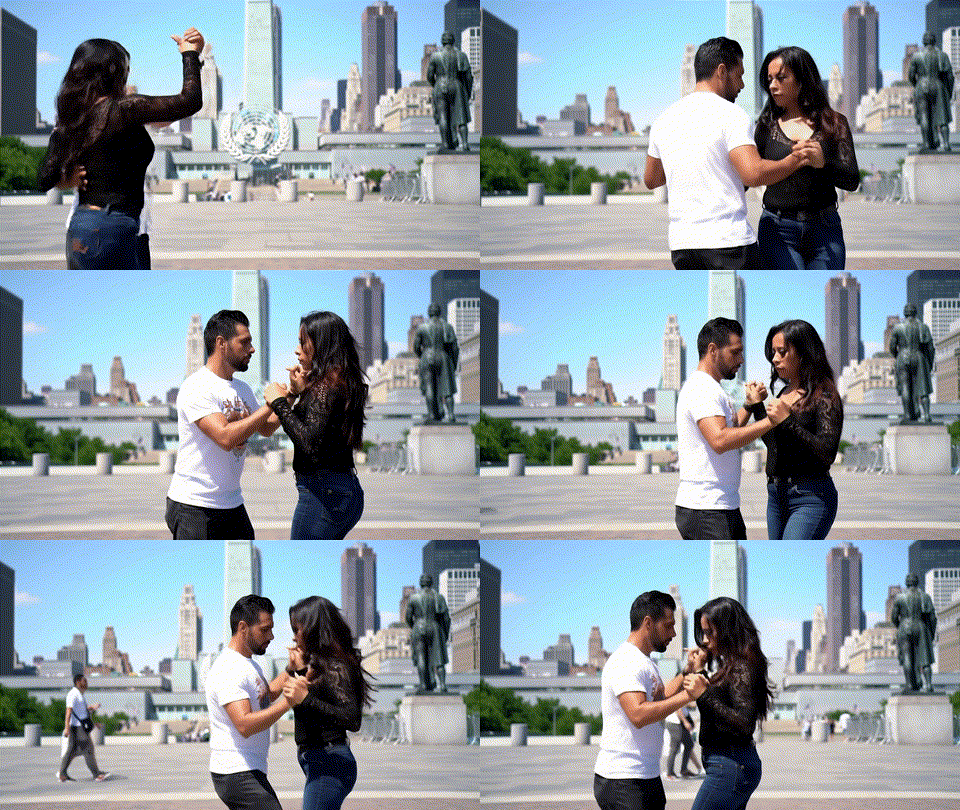
"The French keep kicking the can down the road regarding self-determination for its overseas territories"
Let's talk about the United Nations, the big stage where a lot of this decolonization theater has played out. Back in 1960, they passed this grand-sounding "Declaration on the Granting of Independence to Colonial Countries and Peoples" (Resolution 1514). Noble stuff. They even set up a Special Committee on Decolonization, the C-24, to keep an eye on things. Fast forward to today, and there are still 17 "Non-Self-Governing Territories" on their list. Seventeen. Makes you wonder if the speedy and unconditional end to colonialism they proclaimed got lost in the mail.
Take the Western Sahara, for instance. Spain, the old colonial landlord, packed its bags in 1975. You'd think the UN’s Fourth Committee, tasked with decolonization, would have ticked that one off its list. But no, it’s still kicking around there, even though the UN Security Council treats the Western Sahara as a peace and security issue, not a decolonization one. It’s a peculiar situation where, as some argue, the Committee's role should have wrapped up decades ago. Then you have Algeria, accused by some of playing its own geopolitical games, selectively using the principle of self-determination to back the Polisario Front and challenge Morocco's claims. It's a prime example of how the high-minded ideals of self-determination can get twisted in the gritty reality of international politics, where powerful nations and regional players often call the shots, regardless of what the UN charter says.
And what does it even mean to be a "state" these days? The old Montevideo Convention from 1933 laid out what seemed like clear criteria: A permanent population, a defined territory, a government, and the ability to chat with other countries (engage in international relations). But even these aren't set in stone. The capacity for international relations is no longer just for states. Big companies and NGOs are in on that dance too. And history's shown us that territories can get redrawn and governments can collapse without a state simply vanishing (think Poland in WWII or Somalia in 1992). Now, things like popular will, a democratic government, and even UN membership get thrown into the mix.
Then there's the so-called constitutive approach, which basically says you're a state if other states say you are. Sounds fair, until you realize that recognition can be a political spin, swayed left and right based on who likes whom or who has what to gain.
Consider Palestine. By 2019, 137 countries recognized it, and it's a non-member observer state at the UN. It ticks many of the Montevideo boxes: A Palestinian community in the West Bank and Gaza (despite displacements and settlements); legally recognized territories (even if occupied); a Palestinian Authority (though politically divided and reliant on outside help); and a history of international engagement. Yet, true sovereignty remains elusive, largely due to the ongoing Israeli occupation and the non-recognition of its right to self-determination by key players like the United States and Israel itself.
On the Batey, Puerto Rico provides us a different flavor of this sovereignty paso doble. Recognized as a distinct people, it's been a U.S. colony since 1898. Puerto Ricans are U.S. citizens but can't vote in presidential elections and have a non-voting representative in Congress. The U.S. Constitution’s Territorial Clause grants Congress power over territories, which seems to sit awkwardly with international laws on self-determination that the U.S. itself has championed elsewhere. The island's economy has faced significant blows, like the elimination of Section 936 tax credits that once attracted investment, and the imposition of the PROMESA oversight board to manage its finances, leading to austerity measures. This raises serious questions about whether a "free association" status truly represents self-determination or is a more palatable term for continued colonial oversight.
But decolonization isn't just about political maps and legal statuses. A deeper, perhaps more insidious, form of control is what some scholars call "coloniality". This is not only about who governs, but about how we think – the ways Western perspectives, knowledge systems, and even languages have been imposed and normalized globally. Think about psychology, a field still largely dominated by what's called WEIRD (Western, Educated, Industrialized, Rich, Democratic) perspectives, effectively making a small, unrepresentative slice of humanity the global norm. This epistemic exclusion, or outright epistemic violence disregards or devalues vast swathes of human knowledge and experience simply because they don't fit the Western mold.
This battle for the mind extends to the very language we use. The imposition of colonizers' languages often led to the marginalization or active suppression of Indigenous and local tongues. Reclaiming and revitalizing these languages is a critical part of the decolonization project. It's about more than just communication. It's about identity, culture, and asserting the validity of different ways of seeing the world. This is where initiatives like Indigenous Languages Rights & Realities (ILR&R) come in, as they aim to decolonize academic publishing by centering Indigenous and non-dominant voices, knowledges, and, crucially, their languages. Our own company, working at the intersection of Pacific Island languages and cultural expertise, sees firsthand how essential this linguistic dimension is.
The tussle over the extension of the Canary Islands' continental shelf for example, involving Spain and Morocco, brings into play the unresolved decolonization of Western Sahara and the potential for overlapping claims with Portugal too. The discovery of valuable minerals like tellurium in the disputed area only adds another layer of economic incentive to these geopolitical maneuvers.
That said, the global landscape is shifting, with rising powers like China and India challenging the old Western-centric order. Yet, the response from established powers often seems geared towards maintaining their privileged position. This has led to what some analysts term "post-neocolonialism" or "quasi-coloniality", where exploitation continues through global governance structures and information dominance, affecting former colonies but also nations that were never formally colonized.
Take the Western Sahara, for instance. Spain, the old colonial landlord, packed its bags in 1975. You'd think the UN’s Fourth Committee, tasked with decolonization, would have ticked that one off its list. But no, it’s still kicking around there, even though the UN Security Council treats the Western Sahara as a peace and security issue, not a decolonization one. It’s a peculiar situation where, as some argue, the Committee's role should have wrapped up decades ago. Then you have Algeria, accused by some of playing its own geopolitical games, selectively using the principle of self-determination to back the Polisario Front and challenge Morocco's claims. It's a prime example of how the high-minded ideals of self-determination can get twisted in the gritty reality of international politics, where powerful nations and regional players often call the shots, regardless of what the UN charter says.
And what does it even mean to be a "state" these days? The old Montevideo Convention from 1933 laid out what seemed like clear criteria: A permanent population, a defined territory, a government, and the ability to chat with other countries (engage in international relations). But even these aren't set in stone. The capacity for international relations is no longer just for states. Big companies and NGOs are in on that dance too. And history's shown us that territories can get redrawn and governments can collapse without a state simply vanishing (think Poland in WWII or Somalia in 1992). Now, things like popular will, a democratic government, and even UN membership get thrown into the mix.
Then there's the so-called constitutive approach, which basically says you're a state if other states say you are. Sounds fair, until you realize that recognition can be a political spin, swayed left and right based on who likes whom or who has what to gain.
Consider Palestine. By 2019, 137 countries recognized it, and it's a non-member observer state at the UN. It ticks many of the Montevideo boxes: A Palestinian community in the West Bank and Gaza (despite displacements and settlements); legally recognized territories (even if occupied); a Palestinian Authority (though politically divided and reliant on outside help); and a history of international engagement. Yet, true sovereignty remains elusive, largely due to the ongoing Israeli occupation and the non-recognition of its right to self-determination by key players like the United States and Israel itself.
On the Batey, Puerto Rico provides us a different flavor of this sovereignty paso doble. Recognized as a distinct people, it's been a U.S. colony since 1898. Puerto Ricans are U.S. citizens but can't vote in presidential elections and have a non-voting representative in Congress. The U.S. Constitution’s Territorial Clause grants Congress power over territories, which seems to sit awkwardly with international laws on self-determination that the U.S. itself has championed elsewhere. The island's economy has faced significant blows, like the elimination of Section 936 tax credits that once attracted investment, and the imposition of the PROMESA oversight board to manage its finances, leading to austerity measures. This raises serious questions about whether a "free association" status truly represents self-determination or is a more palatable term for continued colonial oversight.
But decolonization isn't just about political maps and legal statuses. A deeper, perhaps more insidious, form of control is what some scholars call "coloniality". This is not only about who governs, but about how we think – the ways Western perspectives, knowledge systems, and even languages have been imposed and normalized globally. Think about psychology, a field still largely dominated by what's called WEIRD (Western, Educated, Industrialized, Rich, Democratic) perspectives, effectively making a small, unrepresentative slice of humanity the global norm. This epistemic exclusion, or outright epistemic violence disregards or devalues vast swathes of human knowledge and experience simply because they don't fit the Western mold.
This battle for the mind extends to the very language we use. The imposition of colonizers' languages often led to the marginalization or active suppression of Indigenous and local tongues. Reclaiming and revitalizing these languages is a critical part of the decolonization project. It's about more than just communication. It's about identity, culture, and asserting the validity of different ways of seeing the world. This is where initiatives like Indigenous Languages Rights & Realities (ILR&R) come in, as they aim to decolonize academic publishing by centering Indigenous and non-dominant voices, knowledges, and, crucially, their languages. Our own company, working at the intersection of Pacific Island languages and cultural expertise, sees firsthand how essential this linguistic dimension is.
The tussle over the extension of the Canary Islands' continental shelf for example, involving Spain and Morocco, brings into play the unresolved decolonization of Western Sahara and the potential for overlapping claims with Portugal too. The discovery of valuable minerals like tellurium in the disputed area only adds another layer of economic incentive to these geopolitical maneuvers.
That said, the global landscape is shifting, with rising powers like China and India challenging the old Western-centric order. Yet, the response from established powers often seems geared towards maintaining their privileged position. This has led to what some analysts term "post-neocolonialism" or "quasi-coloniality", where exploitation continues through global governance structures and information dominance, affecting former colonies but also nations that were never formally colonized.
In this evolving drama, new actors are also taking the stage. The Baku Initiative Group (BIG), for instance, actively challenges French neocolonial practices (The French keep kicking the can down the road regarding self-determination for its overseas territories) and provides a platform for colonized regions at the UN. These efforts highlight that the struggle for self-determination is multifaceted, from the political quest for statehood in Palestine to Puerto Rico's dance steps with the U.S.
So, where does this leave us? Decolonization, it seems, is less a finished product and more an ongoing, messy, and often contradictory choreography. It's about untangling political and economic dependencies and the colonial threads woven into our knowledge systems, our institutions, and even our ways of speaking and thinking. The path to genuine self-determination is clearly not a straight line, and the final act of this global shuffle is yet to be written. One thing is for sure: the old saxos are still playing, but more and more people are starting to demand a change of music.
So, where does this leave us? Decolonization, it seems, is less a finished product and more an ongoing, messy, and often contradictory choreography. It's about untangling political and economic dependencies and the colonial threads woven into our knowledge systems, our institutions, and even our ways of speaking and thinking. The path to genuine self-determination is clearly not a straight line, and the final act of this global shuffle is yet to be written. One thing is for sure: the old saxos are still playing, but more and more people are starting to demand a change of music.

Huri Translations
Tel. +689 89 205 483
[email protected]
PO BOX 365 Maharepa
98728 Mo'orea
French Polynesia
N°TAHITI 876649


Social