Robotic Solutions for Public Health in the Pacific Islands
In remote locations throughout the Pacific Islands, technological advancements are reshaping how scientific research and public health interventions are conducted. The geographical realities of these island nations have historically presented challenges for implementing large-scale scientific projects. However, innovative robotics applications are now enabling researchers to overcome these barriers in ways that respect local communities and environments while addressing pressing regional concerns like mosquito-borne diseases and marine resource management.
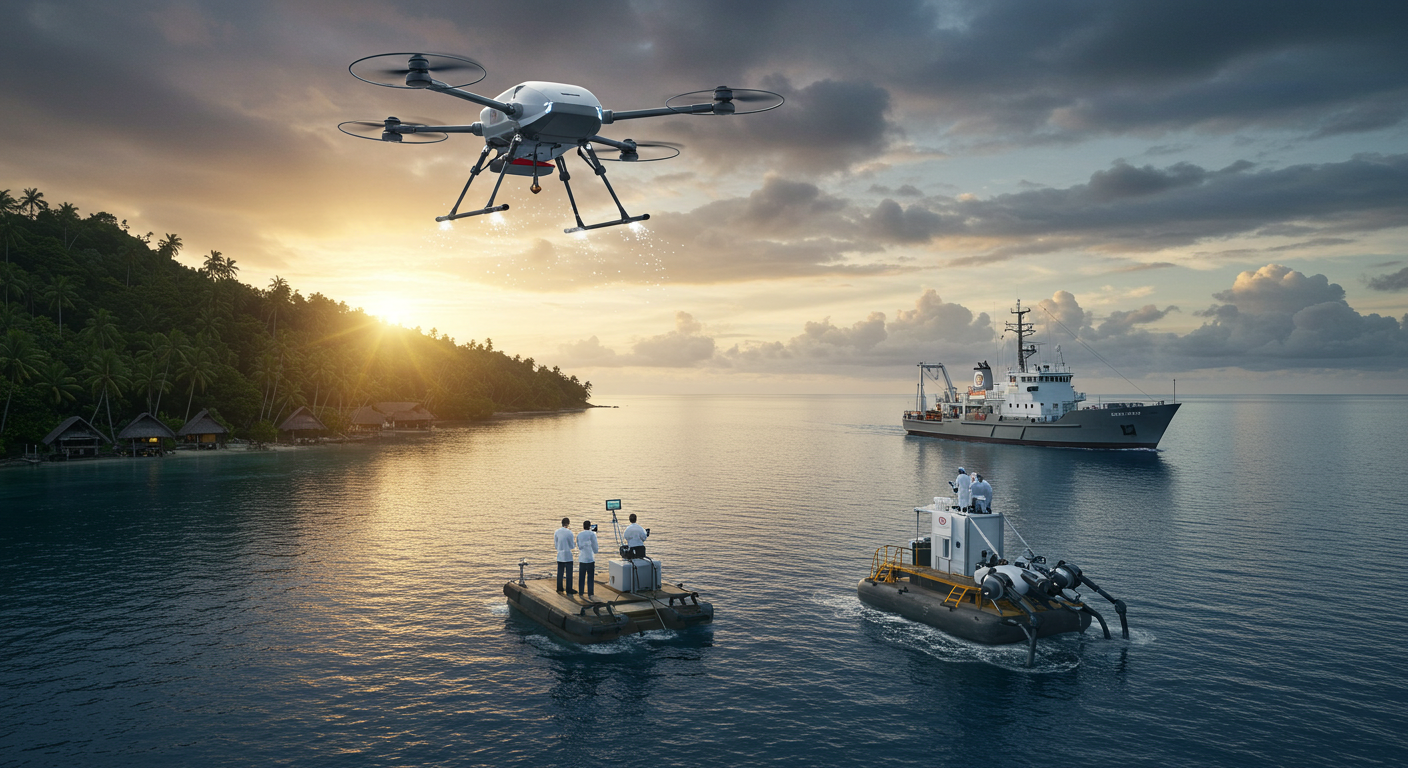
"implementing robotic solutions in the Pacific Islands has its own challenges"
The World Mosquito Program (WMP) has developed an innovative approach to combat dengue fever in Fiji and other Pacific Island nations. Instead of attempting to eliminate mosquito populations entirely, the WMP introduces Wolbachia bacteria into native Aedes aegypti mosquitoes through controlled releases. This method has proven highly effective, with a randomized controlled study in Yogyakarta, Indonesia with a 77% reduction in dengue infections across treatment areas.
The traditional deployment methods involved labor-intensive ground releases of mosquito eggs or adults, which presented significant logistical challenges, particularly in remote Pacific Island communities. To address these limitations, the WMP developed a fully automated mosquito dosing release system integrated into an uncrewed aerial vehicle (UAV) for field trials in Fiji.
The system designed for this purpose contained four mosquito storage canisters capable of carrying approximately 40,000 adult mosquitoes each (160,000 total). Temperature and humidity control units maintained the internal environment at 7-10°C with relative humidity between 60-80% ro prevent mosquitoes from waking up and clumping inside the release mechanism. The release mechanism was designed to distribute mosquitoes in doses of approximately 150 insects per release point.
Laboratory validation showed the release mechanism consistently delivered the target number of mosquitoes with minimal impact on their viability. Tests comparing mosquitoes that had undergone the dosing and release process with control groups showed no significant differences in immediate mortality, longevity, blood-feeding rate, fecundity, or egg hatch rates.
Community engagement was a critical component of the project's success in Fiji. Before commencing field trials, the WMP implemented their Public Acceptance Model to obtain community support. In UAV trial II, prerelease surveys showed that 99% of 103 residents in Nausori were comfortable with and accepted the proposal for UAV-based mosquito releases.
The field trials in Fiji demonstrated that aerial releases could successfully establish Wolbachia infection in native mosquito populations. In the second field trial conducted in a 2 km² area in Nausori, Fiji, from April to September 2019, continuous monitoring showed a steady increase in Wolbachia prevalence over the 14 weeks of releases. Most impressively, the final monitoring in November 2020 showed that the majority of mosquitoes (58.62%) remained Wolbachia-positive one year after releases had concluded.
Meanwhile, oceanographic research in the Pacific Islands has been transformed by telepresence technologies and remotely operated vehicles (ROVs). The Federated States of Micronesia and other Pacific Island nations have extensive marine territories that require scientific investigation, but traditional ship-based research methods face significant constraints due to limited berths on research vessels.
Modern telecommunications and computing systems now allow ocean researchers to transcend the physical constraints of limited ship space, which enables scientists to participate in sea expeditions remotely from land-based or floating facilities. This development has particular relevance for the Pacific Islands, where research vessels sometimes have limited capacity or accessibility.
The concept of "remote science at sea" provides a new model for oceanographic research that is well-suited to the Pacific context. It is defined as a collaborative maritime research mission where teams in multiple locations (both at sea and on land) coordinate their efforts using robotic systems to gather data, all connected through powerful satellite communications.
This approach has been successfully tested in Pacific waters as we saw with the SUBSEA (Systematic Underwater Biogeochemical Science and Exploration Analog) project, which conducted expeditions in 2018 and 2019 that demonstrated how scientists could effectively direct research from shore. During the second expedition to the Gorda Ridge off the coast of Oregon, scientists onshore at the Inner Space Center successfully directed ROV operations without being physically present on the research vessel.
In 2020, when the COVID-19 pandemic created additional barriers to in-person fieldwork, three telepresence-enabled expeditions on the E/V Nautilus in the Pacific showed the value of this approach. Scientists reported that the ability to include more experts, including local knowledge holders who could provide historical and cultural context, enhanced the research outcomes without reducing scientific objectives.
For, language barriers can sometimes complicate scientific work in the Pacific Islands, where numerous indigenous languages are spoken by sometimes as few as 300 people. Remote technologies can help in allowing local experts who speak the vernacular languages to participate from shore while collaborating with international scientists. For instance, in Fiji, where languages like Fijian (Na Vosa Vakaviti), Rotuman and Fiji Hindi are commonly spoken alongside English, remote participation can facilitate better integration of local knowledge.
Nevertheless, implementing robotic solutions in the Pacific Islands has its own challenges. For UAV-based mosquito releases, regulatory requirements for flying high-payload UAVs over populated areas posed significant barriers as, under civil aviation regulation, densely-populated areas are subjected to strictly controlled airspace.
The technical implementation of ROVs for ocean science also faces hurdles. The need for high-bandwidth satellite connections can be problematic in remote Pacific locations where telecommunications infrastructure may be limited. Additionally, the specialized expertise required to operate these systems may not be readily available locally.
Despite these challenges, these applications clearly showcase the potential of robotics to overcome geographical isolation. The UAV-based mosquito release system reduced labor requirements significantly compared to ground-based methods. In field trial I in Nakasi, Fiji, aerial releases required only 2 hours of staff time compared to 6 hours for ground deployment covering the same area.
Robotic technologies are creating new possibilities for public health interventions and scientific research in the Pacific Islands. The successful implementation of UAV-based Wolbachia-infected mosquito releases in Fiji is a pathway for addressing Dengue fever, Zika or Chikungunya. Simultaneously, remote ocean science using ROVs enables more inclusive participation in understanding the marine environments that are so critical to Pacific Island communities.
The system designed for this purpose contained four mosquito storage canisters capable of carrying approximately 40,000 adult mosquitoes each (160,000 total). Temperature and humidity control units maintained the internal environment at 7-10°C with relative humidity between 60-80% ro prevent mosquitoes from waking up and clumping inside the release mechanism. The release mechanism was designed to distribute mosquitoes in doses of approximately 150 insects per release point.
Laboratory validation showed the release mechanism consistently delivered the target number of mosquitoes with minimal impact on their viability. Tests comparing mosquitoes that had undergone the dosing and release process with control groups showed no significant differences in immediate mortality, longevity, blood-feeding rate, fecundity, or egg hatch rates.
Community engagement was a critical component of the project's success in Fiji. Before commencing field trials, the WMP implemented their Public Acceptance Model to obtain community support. In UAV trial II, prerelease surveys showed that 99% of 103 residents in Nausori were comfortable with and accepted the proposal for UAV-based mosquito releases.
The field trials in Fiji demonstrated that aerial releases could successfully establish Wolbachia infection in native mosquito populations. In the second field trial conducted in a 2 km² area in Nausori, Fiji, from April to September 2019, continuous monitoring showed a steady increase in Wolbachia prevalence over the 14 weeks of releases. Most impressively, the final monitoring in November 2020 showed that the majority of mosquitoes (58.62%) remained Wolbachia-positive one year after releases had concluded.
Meanwhile, oceanographic research in the Pacific Islands has been transformed by telepresence technologies and remotely operated vehicles (ROVs). The Federated States of Micronesia and other Pacific Island nations have extensive marine territories that require scientific investigation, but traditional ship-based research methods face significant constraints due to limited berths on research vessels.
Modern telecommunications and computing systems now allow ocean researchers to transcend the physical constraints of limited ship space, which enables scientists to participate in sea expeditions remotely from land-based or floating facilities. This development has particular relevance for the Pacific Islands, where research vessels sometimes have limited capacity or accessibility.
The concept of "remote science at sea" provides a new model for oceanographic research that is well-suited to the Pacific context. It is defined as a collaborative maritime research mission where teams in multiple locations (both at sea and on land) coordinate their efforts using robotic systems to gather data, all connected through powerful satellite communications.
This approach has been successfully tested in Pacific waters as we saw with the SUBSEA (Systematic Underwater Biogeochemical Science and Exploration Analog) project, which conducted expeditions in 2018 and 2019 that demonstrated how scientists could effectively direct research from shore. During the second expedition to the Gorda Ridge off the coast of Oregon, scientists onshore at the Inner Space Center successfully directed ROV operations without being physically present on the research vessel.
In 2020, when the COVID-19 pandemic created additional barriers to in-person fieldwork, three telepresence-enabled expeditions on the E/V Nautilus in the Pacific showed the value of this approach. Scientists reported that the ability to include more experts, including local knowledge holders who could provide historical and cultural context, enhanced the research outcomes without reducing scientific objectives.
For, language barriers can sometimes complicate scientific work in the Pacific Islands, where numerous indigenous languages are spoken by sometimes as few as 300 people. Remote technologies can help in allowing local experts who speak the vernacular languages to participate from shore while collaborating with international scientists. For instance, in Fiji, where languages like Fijian (Na Vosa Vakaviti), Rotuman and Fiji Hindi are commonly spoken alongside English, remote participation can facilitate better integration of local knowledge.
Nevertheless, implementing robotic solutions in the Pacific Islands has its own challenges. For UAV-based mosquito releases, regulatory requirements for flying high-payload UAVs over populated areas posed significant barriers as, under civil aviation regulation, densely-populated areas are subjected to strictly controlled airspace.
The technical implementation of ROVs for ocean science also faces hurdles. The need for high-bandwidth satellite connections can be problematic in remote Pacific locations where telecommunications infrastructure may be limited. Additionally, the specialized expertise required to operate these systems may not be readily available locally.
Despite these challenges, these applications clearly showcase the potential of robotics to overcome geographical isolation. The UAV-based mosquito release system reduced labor requirements significantly compared to ground-based methods. In field trial I in Nakasi, Fiji, aerial releases required only 2 hours of staff time compared to 6 hours for ground deployment covering the same area.
Robotic technologies are creating new possibilities for public health interventions and scientific research in the Pacific Islands. The successful implementation of UAV-based Wolbachia-infected mosquito releases in Fiji is a pathway for addressing Dengue fever, Zika or Chikungunya. Simultaneously, remote ocean science using ROVs enables more inclusive participation in understanding the marine environments that are so critical to Pacific Island communities.

Huri Translations
Tel. +689 89 205 483
[email protected]
PO BOX 365 Maharepa
98728 Mo'orea
French Polynesia
N°TAHITI 876649


Social