The Pattern of Becoming: From Stardust, From Cells, From Thought
There are patterns in the way things come to be. We see them in the universe's great architecture. We see them in the persistent structures life builds on our planet. And we find them in the sacred stories humanity has told for millennia. They speak to underlying processes, to ways of organizing. Our work with Pacific Island languages often involves recognizing such patterns in expression and worldviews. This is a look at some of these convergences — from the cosmos, to ecosystems, to the narratives that shape us.
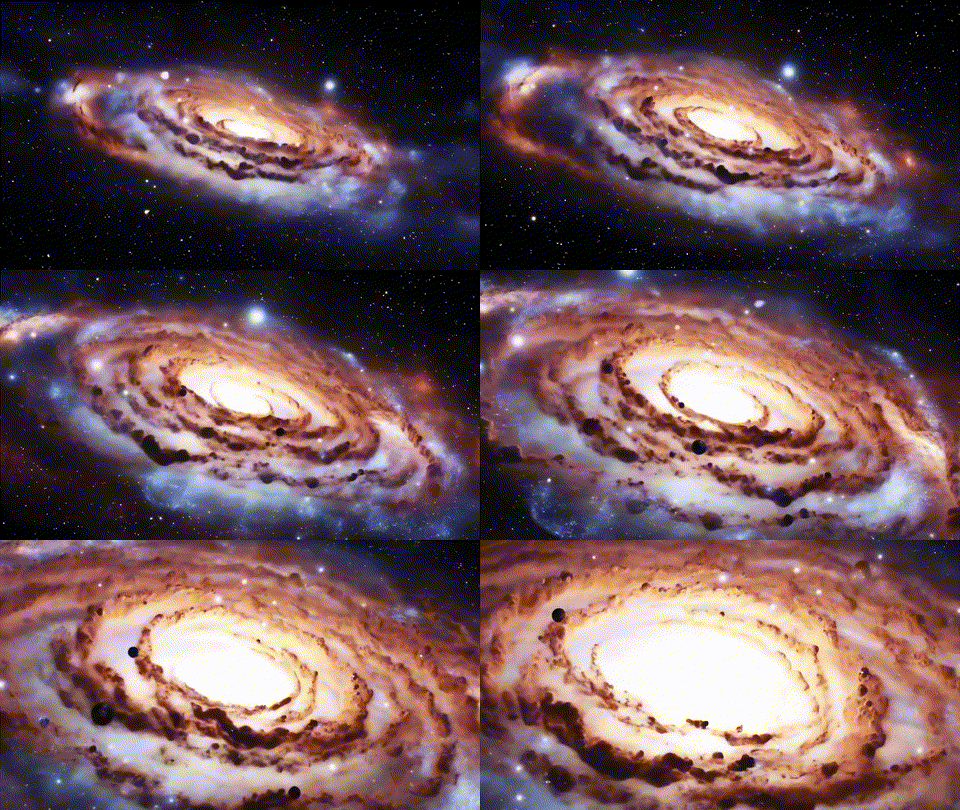
"answer the metaphysical questions about origins, existence, and destiny"
Consider the way dark matter halos, the huge scaffolds of galaxies, take form. They are built, particle by particle, drawn together by gravity from what was once a more uniform spread of matter. Over eons, these particles trace pathlines. Visualizing these paths, as done with simulations like TNG50-3 shows how matter converges, forming filamentary density enhancements — the root systems of these cosmic giants. These are the fingerprints of their mass assembly. The process is a slow accretion, a gathering that creates a huge, branched structure.
Down on Earth, coral reefs achieve their grandeur through a similar principle of cumulative local action. Individual coral polyps, tiny organisms, interact with their environment, accreting aragonite, the very stuff of the reef. A model exploring this development uses two key fields: P, the density of living coral, and A, the accumulated aragonite which directly translates to reef height. This model doesn't rely on a classical pattern-forming mechanism like a Turing scenario. Instead, it incorporates fundamental ecological and physical processes: coral growth, which can be enhanced by light at certain heights, faces mortality from drying if the reef grows too close to the surface, and competes for space. These interactions can give rise to a so-called excitable behavior, where the system can shift dramatically in response to conditions, leading to large-scale structures like atolls and fringing reefs.
This idea of a structured world arising from something more elemental, more primordial, echoes in many ancient creation stories. Michael Witzel's research into Laurasian mythology points to a common storyline across much of Eurasia and the pre-Columbian Americas. These narratives often begin with an emergence from an undifferentiated state — perhaps darkness, a void, or primeval waters. The oldest Indian texts, the Rigveda, from around 1500-1200 BCE, describe the world originating from neither being nor non-being, or a vast, featureless ocean. From this initial condition, order and form gradually appear, often through divine action or successive generations of deities.
Now, the root systems of cosmic halos are not static blueprints. They represent a projection of a halo through time. They are a physical, geometric version of a merger tree, showing the actual pathways matter took. This is different from an abstract chart since it’s the visual record of growth.
Coral reefs also tell a story of development through their forms. The traveling pulses identified in the reef model are key to this. These are random growths and they are self-sustained, propagating structures of coral and aragonite that actively expand the reef. A single such pulse might form a fringing reef along a coastline. Two pulses, originating from a central point and moving in opposite directions, can create the characteristic ring shape of an atoll. The system's capacity for such excitable excursions, often emerging beyond a Saddle-Loop bifurcation, means that local growth can initiate a wave of construction that shapes the reef over considerable distances.
This notion of a developmental narrative finds a compelling parallel in Witzel’s interpretation of the Laurasian mythological cycle. He suggests this entire sequence — from the universe's first stirrings, through the ages of gods and heroes, to humanity's appearance, and an eventual world end with prospects of renewal — is analogous to the human life cycle. The cosmos, in this view, undergoes its own birth, maturation, decline, and potential rebirth, a story that gives human existence a place within a larger, cyclical narrative.
The specific forms that emerge in these different domains are not arbitrary. For cosmic halos, parameters like mass and spin are determinate. Larger, more massive halos tend to develop more roots and more intricate branching in their root systems. Halos with high spin exhibit curvier, more tortuous roots. These are intrinsic properties shaping the outcome.
In the coral reef ecosystem, the environment's rules are equally definitive. The mathematical model demonstrates this through its parameters, chiefly the rescaled mortality rate for coral (α) and the rescaled erosion rate for aragonite (ϵ). The interplay of these factors dictates the reef's fate. Varying these conditions can lead to a barren seabed, a stable and thriving coral population, or the dynamic, structure-forming traveling pulses. For instance, stable traveling pulses that can form atoll-like structures are typically found in regions of the parameter space where erosion values are low.
Mythological systems, too, appear to follow underlying codes. Witzel’s Laurasian theory posits such a common narrational scheme. This scheme — origins, divine generations, heroes, humanity, end-times — acts as a kind of deep structural framework. Grasping these foundational patterns in diverse cultural expressions, like those found in Pacific Island languages, is a significant part of achieving genuine understanding in translation. It's about seeing the whole grammar, as Witzel puts it. His comparative method itself draws an analogy to historical linguistics, which reconstructs parent languages from their descendants. Think, Proto-Polynesian, Proto-Malayo-Polynesian, Proto-Oceanic, Proto-Central-Pacific, Proto-Eastern Malayo-Polynesian, etc.
When we look broadly, certain fundamental ways of coming-into-being seem to echo. The root systems of halos are described as one example of branching networks found in nature, with analogies drawn to systems like tree roots or blood vessels, though operating on vastly different principles and scales. The process is one of directed accretion and connection.
The coral reef model, based on a few core ecological and physical mechanisms, produces formations that look like actual reefs. This emergence of patterns from spatio-temporal excitable dynamics seems not isolated to corals. Similar behaviors are seen in models for other sessile organisms, like certain types of vegetation or fungi. There's a shared logic to how these systems can organize.
And in mythology, specific motifs of creation recur across the Laurasian world with persistence. The idea of the earth emerging from primeval waters, for example, is extensively documented. The Finnish Kalevala offers a combined narrative where a bird's eggs, laid on a divine being floating in the primordial sea, break to form the cosmos. The cosmic egg itself is a widespread theme. These are not identical stories, but they are variations on a theme, building blocks of a shared human attempt to explain origins.
These references — filamentary structures in space, propagating growth in ecosystems, recurring narratives in human culture — don't necessarily mean all these things are the same. But they do point to common ways that order can arise, that history can be recorded in form, and that meaning can be constructed. The Laurasian myths, as Witzel outlines, aimed to answer the metaphysical questions about origins, existence, and destiny. That endeavor, to find patterns and to understand our place, continues. The questions remain open, and the search itself shapes who we are.
Down on Earth, coral reefs achieve their grandeur through a similar principle of cumulative local action. Individual coral polyps, tiny organisms, interact with their environment, accreting aragonite, the very stuff of the reef. A model exploring this development uses two key fields: P, the density of living coral, and A, the accumulated aragonite which directly translates to reef height. This model doesn't rely on a classical pattern-forming mechanism like a Turing scenario. Instead, it incorporates fundamental ecological and physical processes: coral growth, which can be enhanced by light at certain heights, faces mortality from drying if the reef grows too close to the surface, and competes for space. These interactions can give rise to a so-called excitable behavior, where the system can shift dramatically in response to conditions, leading to large-scale structures like atolls and fringing reefs.
This idea of a structured world arising from something more elemental, more primordial, echoes in many ancient creation stories. Michael Witzel's research into Laurasian mythology points to a common storyline across much of Eurasia and the pre-Columbian Americas. These narratives often begin with an emergence from an undifferentiated state — perhaps darkness, a void, or primeval waters. The oldest Indian texts, the Rigveda, from around 1500-1200 BCE, describe the world originating from neither being nor non-being, or a vast, featureless ocean. From this initial condition, order and form gradually appear, often through divine action or successive generations of deities.
Now, the root systems of cosmic halos are not static blueprints. They represent a projection of a halo through time. They are a physical, geometric version of a merger tree, showing the actual pathways matter took. This is different from an abstract chart since it’s the visual record of growth.
Coral reefs also tell a story of development through their forms. The traveling pulses identified in the reef model are key to this. These are random growths and they are self-sustained, propagating structures of coral and aragonite that actively expand the reef. A single such pulse might form a fringing reef along a coastline. Two pulses, originating from a central point and moving in opposite directions, can create the characteristic ring shape of an atoll. The system's capacity for such excitable excursions, often emerging beyond a Saddle-Loop bifurcation, means that local growth can initiate a wave of construction that shapes the reef over considerable distances.
This notion of a developmental narrative finds a compelling parallel in Witzel’s interpretation of the Laurasian mythological cycle. He suggests this entire sequence — from the universe's first stirrings, through the ages of gods and heroes, to humanity's appearance, and an eventual world end with prospects of renewal — is analogous to the human life cycle. The cosmos, in this view, undergoes its own birth, maturation, decline, and potential rebirth, a story that gives human existence a place within a larger, cyclical narrative.
The specific forms that emerge in these different domains are not arbitrary. For cosmic halos, parameters like mass and spin are determinate. Larger, more massive halos tend to develop more roots and more intricate branching in their root systems. Halos with high spin exhibit curvier, more tortuous roots. These are intrinsic properties shaping the outcome.
In the coral reef ecosystem, the environment's rules are equally definitive. The mathematical model demonstrates this through its parameters, chiefly the rescaled mortality rate for coral (α) and the rescaled erosion rate for aragonite (ϵ). The interplay of these factors dictates the reef's fate. Varying these conditions can lead to a barren seabed, a stable and thriving coral population, or the dynamic, structure-forming traveling pulses. For instance, stable traveling pulses that can form atoll-like structures are typically found in regions of the parameter space where erosion values are low.
Mythological systems, too, appear to follow underlying codes. Witzel’s Laurasian theory posits such a common narrational scheme. This scheme — origins, divine generations, heroes, humanity, end-times — acts as a kind of deep structural framework. Grasping these foundational patterns in diverse cultural expressions, like those found in Pacific Island languages, is a significant part of achieving genuine understanding in translation. It's about seeing the whole grammar, as Witzel puts it. His comparative method itself draws an analogy to historical linguistics, which reconstructs parent languages from their descendants. Think, Proto-Polynesian, Proto-Malayo-Polynesian, Proto-Oceanic, Proto-Central-Pacific, Proto-Eastern Malayo-Polynesian, etc.
When we look broadly, certain fundamental ways of coming-into-being seem to echo. The root systems of halos are described as one example of branching networks found in nature, with analogies drawn to systems like tree roots or blood vessels, though operating on vastly different principles and scales. The process is one of directed accretion and connection.
The coral reef model, based on a few core ecological and physical mechanisms, produces formations that look like actual reefs. This emergence of patterns from spatio-temporal excitable dynamics seems not isolated to corals. Similar behaviors are seen in models for other sessile organisms, like certain types of vegetation or fungi. There's a shared logic to how these systems can organize.
And in mythology, specific motifs of creation recur across the Laurasian world with persistence. The idea of the earth emerging from primeval waters, for example, is extensively documented. The Finnish Kalevala offers a combined narrative where a bird's eggs, laid on a divine being floating in the primordial sea, break to form the cosmos. The cosmic egg itself is a widespread theme. These are not identical stories, but they are variations on a theme, building blocks of a shared human attempt to explain origins.
These references — filamentary structures in space, propagating growth in ecosystems, recurring narratives in human culture — don't necessarily mean all these things are the same. But they do point to common ways that order can arise, that history can be recorded in form, and that meaning can be constructed. The Laurasian myths, as Witzel outlines, aimed to answer the metaphysical questions about origins, existence, and destiny. That endeavor, to find patterns and to understand our place, continues. The questions remain open, and the search itself shapes who we are.

Huri Translations
Tel. +689 89 205 483
[email protected]
PO BOX 365 Maharepa
98728 Mo'orea
French Polynesia
N°TAHITI 876649


Social