Moving the Pacific Plate
In the Pacific Islands, where marine ecosystems command 98% of territorial jurisdiction and sustain over 1,000 documented foodfish species, a changing dietary phenomenon has taken root. While these island nations possess perhaps the world's most comprehensive maritime protein resources, several Pacific territories have ascended to the uppermost echelons of global meat consumption.
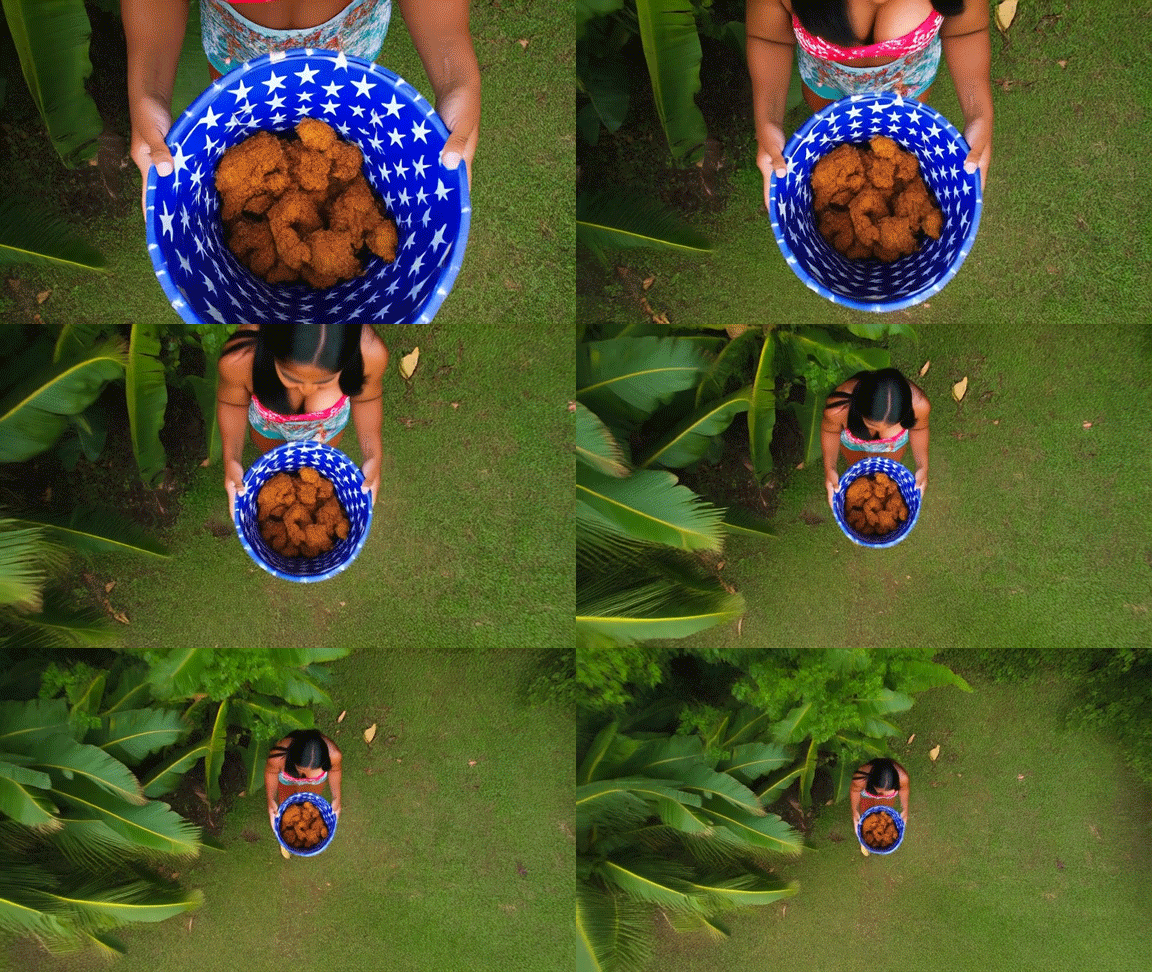
"French Polynesia comes 2nd in beef consumption"
Data from the Food and Agriculture Organization (FAO) of the United Nations for 2022 sheds light on this geographic irony with startling precision. Regarding poultry, PICTs rank first in global consumption. For instance, Saint Vincent and the Grenadines reported a whopping per capita consumption of 94 kg, while Tonga and the Marshall Islands ate 91 kg and 74 kg respectively. Sāmoa also shows notable poultry consumption at 74 kg per capita. Other PICTs such as French Polynesia (47 kg), Nauru (47 kg), and Tuvalu (42 kg) also show substantial poultry intake. Fiji's consumption stands at 37 kg, while the Federated States of Micronesia stands at 38 kg. In contrast, Papua New Guinea (around 3 kg) and Solomon Islands (9 kg) show considerably lower levels. These figures can be contextualized by looking at global high consumers like Israel (71 kg) or the United States (53 kg).
The magnitude of this transformation becomes more apparent when contextualized against traditional dietary patterns. Pacific peoples historically sustained themselves through food systems that included plant-based staples supplemented by fresh marine proteins. Contemporary surveys document that Pacific Island Countries now exhibit some of the world's highest rates of obesity and cardio-vascular diseases while simultaneously importing substantial quantities of poultry, bovine and processed meat products.
Islands like Trinidad & Tobago exemplify this dietary dichotomy, where poultry constitutes an estimated 86% of total protein consumption, totaling approximately 44,000 metric tonnes annually. Local production meets between 60-70% of national demand, and imports complete the remainder. This dependency on land-based proteins occurs despite the Caribbean's position within some of the world's most productive fishing waters, where traditional marine resources historically provided the foundation of regional food security.
In fact, multiple convergent forces drive these consumption patterns. Globalization and trade liberalization policies have facilitated the mass introduction of processed foods throughout Pacific markets, while climate variability increasingly disrupts traditional food systems. Extended wet or dry seasons destabilize local agricultural production, while extreme weather events destroy both crops and fishing infrastructure. Added to historical contexts such as the commodity of meat refrigeration, these disruptions push fresh food prices upward, rendering processed alternatives economically attractive compared to traditional options requiring extensive preparation time.
Urbanization compounds these pressures by limiting land access for traditional gardening while increasing cash economy participation. This economic transition improves affordability of convenience foods while reducing time available for traditional food preparation — a consideration particularly relevant for working mothers who function as household food gatekeepers. Take urban indigenous Samoan mothers for instance. They are responsible for family meal planning and preparation, and increasingly prioritize foods that provide satiation between meals, often gravitating toward energy-dense options that may not align with traditional nutritional paradigms and more interestingly, genetic dispositions.
Food choice analysis among Pacific populations reveals the multifaceted nature of contemporary dietary decisions. Taste preferences, particularly those of family members, significantly influence meal planning decisions, sometimes leading mothers to prepare foods they recognize as suboptimal to accommodate household preferences. Convenience emerges as another primary motivator, especially among working mothers and full-time students who opt for processed foods requiring minimal preparation time.
Religious dietary restrictions also shape food choices within certain communities. Seventh Day Adventist populations report incorporating more plant-based options while avoiding processed foods, though they attribute these choices primarily to scriptural observance rather than health considerations. These communities indicate that alternative dietary patterns remain viable within Pacific contexts when supported by appropriate cultural frameworks
Access considerations further influence dietary choices, with preferences for seasonal produce and ingredients available in home gardens competing against the convenience of imported processed alternatives. Fresh foods from wet markets command preference over processed options, though time and financial constraints often means to compromise. The seasonal availability of local produce creates cyclical patterns where fresh options alternate with convenience foods based on agricultural cycles.
That said, the marine abundance documented throughout Pacific territories creates an apparent paradox when considered alongside these dietary trends. Indeed, despite access to over 1,000 edible fish species, Andrew NL et al. show in Pacific Conservation Biology that many Pacific communities increasingly rely on imported processed proteins. Small reef species, which comprise approximately 82% of the regional marine foodfish inventory, may be underfished due to their size and the labor-intensive nature of their harvest and preparation.
Now, global meat consumption rankings further corroborate these regional anomalies. While Argentina leads worldwide beef consumption at 46 kilograms per capita annually, French Polynesia comes 2nd on the list, and leads among the listed PICTs with 33 kg per capita, followed by New Caledonia at 22 kg and Nauru at 21 kg. The Marshall Islands and Tonga reported 14 kg. Sāmoa’s consumption was 11 kg. Conversely, Fiji's annual per-capita meat intake was around 4 kg, Federated States of Micronesia 6 kg, and Vanuatu 7 kg. Papua New Guinea and Solomon Islands reported even lower figures, with 1 kg and 2 kg respectively.
In sum, traditional knowledge systems that sustained populations for millennia coexist with rapidly changing food environments shaped by globalization, climate change, and technological advancement. Whether these societies will reconcile their marine heritage with contemporary dietary realities — or continue diverging toward processed food dependence — remains an open question with implications extending beyond nutritional outcomes to encompass cultural identity, economic sustainability, healthcare policies and environmental stewardship across the Pacific's maritime territories. The resolution of this paradox may well determine whether island nations can maintain food sovereignty while adapting to twenty-first-century realities.

Huri Translations
Tel. +689 89 205 483
[email protected]
PO BOX 365 Maharepa
98728 Mo'orea
French Polynesia
N°TAHITI 876649


Social