Culturally Responsive Approaches to Health Technology Design in the Pacific Islands
The intersection of health technology and cultural responsiveness presents significant opportunities for improving healthcare outcomes in the Pacific Islands. As robotic rehabilitation devices and other health technologies continue to develop globally, there is a growing need to ensure these innovations are designed with cultural considerations in mind.
"machine learning offers promising tools for better understanding the health and wellbeing needs of our Pacific Island populations"
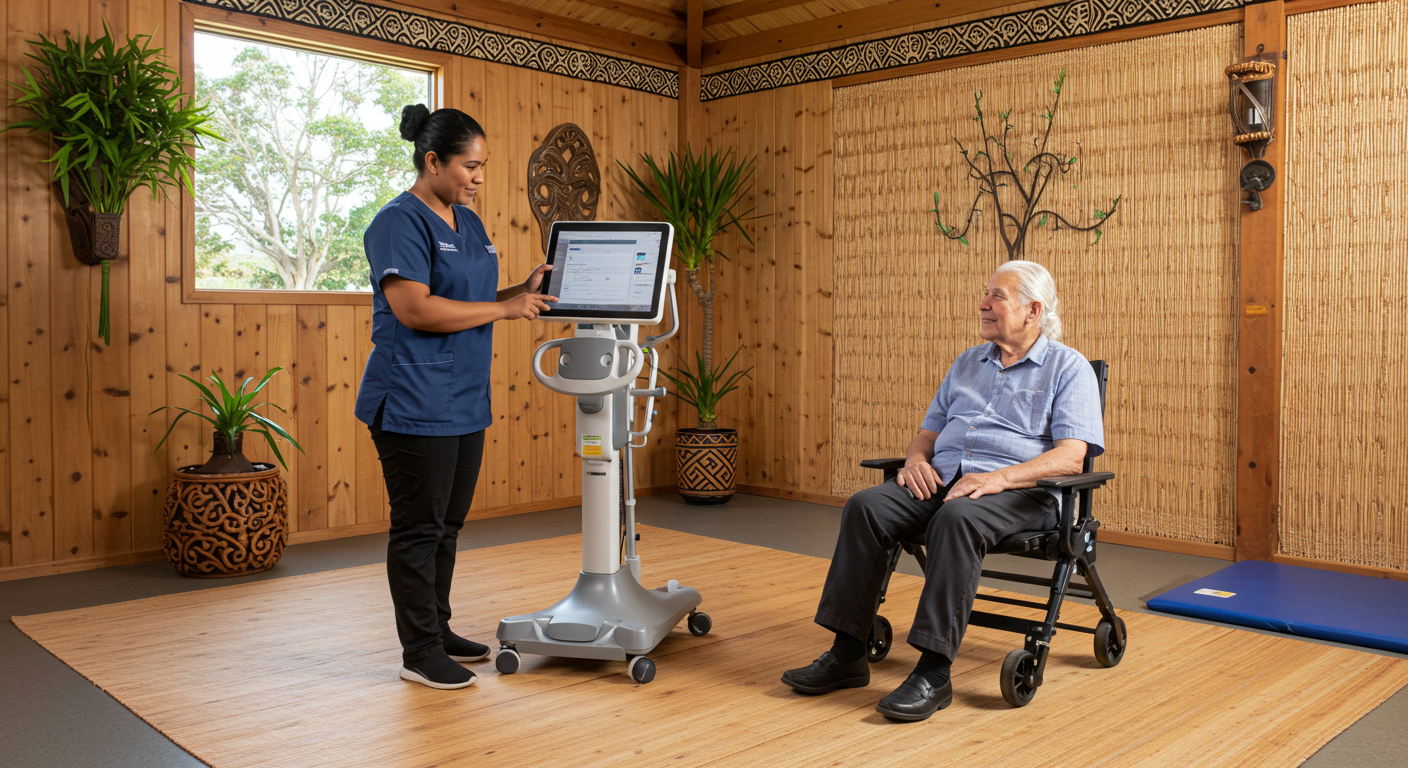
Health technologies encompass a wide range of tools, devices, software, and systems used to improve health outcomes or deliver healthcare services. From wearables that provide objective data to robotic devices that augment rehabilitation, these technologies have shown promise in revolutionizing healthcare delivery. In stroke rehabilitation specifically, robotic devices have demonstrated effectiveness comparable to conventional rehabilitation methods, with benefits attributed to their ability to facilitate repetitive, high-intensity, task-specific training.
However, the uptake of robotic devices in clinical settings remains limited throughout the Pacific region. This limited adoption may reflect incomplete knowledge about what robotic devices should entail to deliver effective rehabilitation outcomes, or how rehabilitation programs should be designed to support their implementation in clinical practice.
One critical factor limiting the adoption of health technologies in Pacific Island communities is cultural bias in design. Cultural bias refers to the presence of assumptions, stereotypes, and preferences of particular cultural groups that influence technology design, potentially leading to solutions that don't fully meet the needs of diverse populations.
For instance, in Aotearoa, research demonstrates that the healthcare system often fails to meet the needs of the Māori communities. Māori stroke survivors are less likely to have access to specialist stroke services, they are 1.5 times less likely to receive the recommended minimum amount of rehabilitation, and they experience poorer outcomes in function and quality of life. These inequities reflect a global trend seen in many indigenous communities across the Pacific.
Consequently, researchers interested in developing health technologies for Pacific Island communities must consider how their research methodologies themselves might need to be transformed to be culturally responsive. The experience of a research team in Aotearoa give us a direction on where to go.
One critical factor limiting the adoption of health technologies in Pacific Island communities is cultural bias in design. Cultural bias refers to the presence of assumptions, stereotypes, and preferences of particular cultural groups that influence technology design, potentially leading to solutions that don't fully meet the needs of diverse populations.
For instance, in Aotearoa, research demonstrates that the healthcare system often fails to meet the needs of the Māori communities. Māori stroke survivors are less likely to have access to specialist stroke services, they are 1.5 times less likely to receive the recommended minimum amount of rehabilitation, and they experience poorer outcomes in function and quality of life. These inequities reflect a global trend seen in many indigenous communities across the Pacific.
Consequently, researchers interested in developing health technologies for Pacific Island communities must consider how their research methodologies themselves might need to be transformed to be culturally responsive. The experience of a research team in Aotearoa give us a direction on where to go.
The team underwent a process of adapting their qualitative research protocol for exploring robotic device features for upper-limb stroke rehabilitation to better reflect Māori concepts of health and wellbeing. Their adaptation process began with assembling a team that included indigenous researchers and prioritizing Whakawhanaungatanga (relationship-building) among team members.
The team drew from Te Ao Māori (Māori world views) ethical principles, models of health, and frameworks for culturally responsive research practice. For instance, they utilized the Meihana model, which depicts health as a journey in a Waka Hourua (double-hulled canoe) where the person and their Whānau (extended family) travel toward Hauora (wellbeing). This model acknowledges physical health alongside psychological wellbeing, spirituality, environmental factors, and service systems.
In practice, adapting research methodologies meant fundamental changes to the original research protocol. Instead of including Māori clinicians as a subsection of a broader study, the team recognized that this approach would not sufficiently honor Māori perspectives. They redesigned their study to explore the perspectives of Māori clinicians as an independent inquiry, drawing from Kaupapa Māori research principles to prioritize Māori practices, knowledge, and values.
Data collection methods were adapted to incorporate Tikanga Māori (culturally safe practices). For example, the team adopted the Hui Process, a framework of clinical engagement designed to follow the structure of a traditional Māori gathering. This process includes Mihimihi (initial greeting), Whakawhanaungatanga, Kaupapa (attending to the purpose), and Poroaki (closing the session).
Interview questions were also reframed to better reflect Māori concepts of health and wellbeing. Rather than asking "If you could design a system for upper-limb stroke rehabilitation, what would it entail?", questions were reframed as "How do you tailor your rehabilitation approach to meet the needs of Māori?" and "How can a device strengthen someone's Wairua (spirituality), or a spiritual connection to Whānau, or Whenua (land)?"
These research adaptations yielded richer insights that might otherwise have been missed. For example, participants described observing how the healthcare system amplified inequities, including access to healthcare technologies such as rehabilitation robotics. Some clinicians described the daily challenge of seeing Māori with stroke struggling to navigate a healthcare system that doesn't adequately support them, while simultaneously working as part of that system.
In addition to culturally responsive methodologies, machine learning offers promising tools for better understanding the health and wellbeing needs of our Pacific Island populations. Recent research in Aotearoa has explored using machine learning models to predict subjective wellbeing outcomes from administrative data sources. While these models showed reasonable predictive accuracy for metrics like life satisfaction, life worthwhileness, family wellbeing, and mental wellbeing (with Random Forest models performing best), they also revealed limitations in capturing the variability in wellbeing outcomes.
Furthermore, insights from the MaaraTech project have highlighted the importance of purposeful co-design approaches when developing agricultural technologies. This project emphasized the value of including diverse end-users in the design process, particularly agricultural workers who are often left out of technology design conversations. Through an anticolonial co-design methodology, researchers were able to ethically include agricultural workers' insights, which proved invaluable for understanding how technologies might integrate into workplace settings.
The MaaraTech project's approach to responsible innovation is a great example of health technology design in the Pacific. Their framework of anticipation (considering future impacts), inclusion (engaging diverse stakeholders), responsiveness (identifying and addressing issues as they arise), and reflexivity (reflecting on values and beliefs) provides a useful structure for developing culturally responsive health technologies.
The cultural adaptation process also has implications for linguistic considerations in health technology design throughout the Pacific Islands. Just as research methodologies needed to incorporate Māori concepts and terminology (remember, Hauora, Wairua, Whānau, and Whenua), health technologies developed for Pacific Island communities must consider local languages and communication patterns.
For example, rehabilitation robots might need to incorporate voice interfaces that recognize and respond to Pacific Island languages, including different dialects and speech patterns. User interfaces might need to incorporate culturally meaningful imagery and metaphors rather than those developed primarily for Western contexts.
The journey toward culturally responsive health technology design in the Pacific Islands requires transformation at multiple levels. From research methodologies to technological features, cultural responsiveness must be woven throughout the design process. This approach not only addresses inequities in healthcare access and outcomes but also enhances the effectiveness and adoption of health technologies.

Huri Translations
Tel. +689 89 205 483
[email protected]
PO BOX 365 Maharepa
98728 Mo'orea
French Polynesia
N°TAHITI 876649


Social