Maneuvering in the Crosscurrents of AUKUS
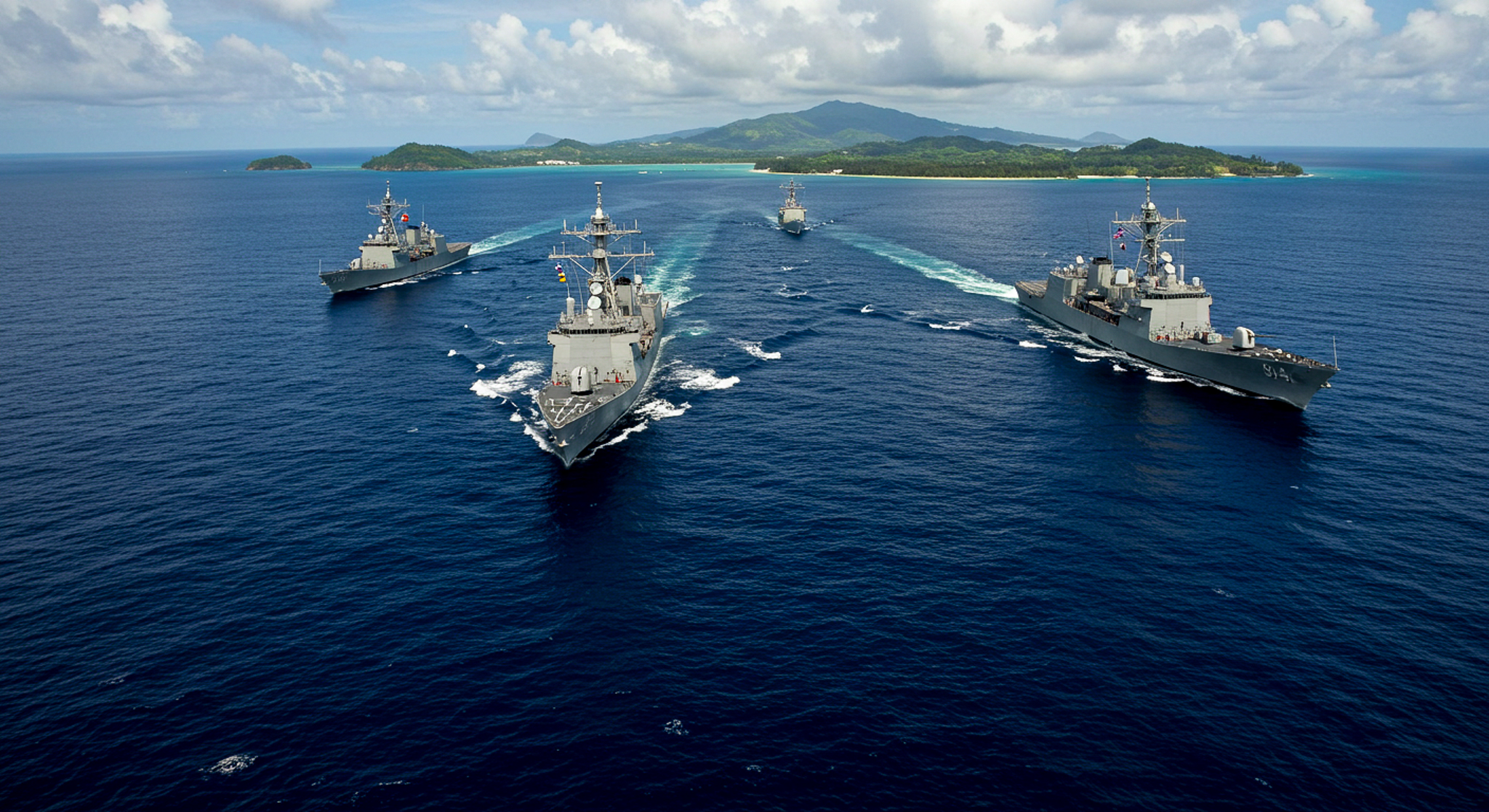
The 2021 establishment of the Australia-UK-U.S. security pact known as AUKUS has intensified geopolitical competition between the U.S. and China in the Indo-Pacific region. Consequently, the Pacific Island nations find ourselves at the center of renewed great power rivalry, which presents opportunities and risks as we chart our course through an increasingly turbulent regional seascape.
"collective regional agency and identity"
From the viewpoint of many Pacific leaders, the region must not become a pawn in great power competition. The islands have painful collective memories of being used as nuclear testing grounds by the U.S., UK and France during the Cold War era, with enduring impacts on health and ecology. As AUKUS raises the specter of increased militarization, leaders like Solomon Islands Prime Minister Jeremiah Manele have voiced skepticism about whether Pacific priorities will be genuinely addressed.
However, some Pacific states also perceive potential benefits in the heightened engagement and resources that AUKUS could bring. Palau, for instance, has signaled openness to hosting new U.S. military facilities as a counterbalance to China's growing regional presence. The pact's promise of expanded support for infrastructure development, technology sharing, and economic assistance could provide a fillip to island economies if delivered in a responsive, sustainable manner attuned to local needs.
Moreover, if AUKUS opens the door to robust cooperation on issues like climate resilience that are existential for the Pacific, it may gain more traction. Recent initiatives like the Partners in the Blue Pacific program suggest the U.S. and allies are recognizing the need to better align with islander priorities. Delivering tangible results on the ground will be paramount to building trust and goodwill.
In fact, AUKUS is unlikely to fundamentally alter the Pacific preference for an inclusive, multi-partner regional architecture. Groups like the Pacific Islands Forum will remain the primary mechanisms for advancing collective interests on the global stage. Even as AUKUS stirs debate, Pacific countries are expected to uphold their "friends to all, enemies to none" ethos, engaging pragmatically with a diverse set of partners to meet development aspirations and strategic objectives.
To maneuver in these geopolitical crosscurrents skillfully, Pacific diplomacy draws on the islander concept of relational governance. Former Samoan Prime Minister Tuilaʻepa Saʻilele Malielegaoi had invoked this principle, noting Pacific expertise in "navigating the larger powers and those who have set rules". Like expert wayfinders who study celestial bodies, ocean swells, and wildlife to find their way, islanders are adept at carefully reading the geopolitical currents to chart a course that balances "mutual contradictions" and preserves autonomy.
This diplomatic acuity is reflected in the measured, mediating language Pacific leaders often employ in discussing sensitive issues. Terms like "inclusive", "multi-partner," "rules-based" and "balance" are frequently invoked to convey the desire to engage constructively with all parties while avoiding zero-sum alignments. The persistent use of "tātou" - first-person plural inclusive pronoun instead of "mātou" - first person plural exclusive - asserts collective regional agency and identity, which our teams clearly identify while translating the English first-person plural pronoun "we" in Samoan, Māori, Rarotongan, etc.
For the U.S. and allies, recognizing and supporting Pacific self-determination will be essential to achieving their strategic aims in the region. Heavy-handed actions that project an image of paternalism or military overreach are likely to backfire given sensitivities around past imperial excesses. A more supple touch that respects Pacific ways and amplifies islander-led initiatives will prove more fruitful in the long run.
Ultimately, the Pacific is poised to be a critical hinge point in 21st century geopolitics. By attuning to the range of islander voices and perspectives, a fine-grained picture emerges that resists facile narratives of dueling spheres of influence. Pacific diplomacy offers a valuable model for maneuvering in an era of intensifying great power rivalry with prudence and principle. The region's deft management of the mutual contradictions that define today's Indo-Pacific will have far-reaching implications for the future of AUKUS and the wider world.

Huri Translations
Tel. +689 89 205 483
[email protected]
PO BOX 365 Maharepa
98728 Mo'orea
French Polynesia
N°TAHITI 876649


Social