When Climate Science Gets Lost at Sea
Across the Pacific Ocean, a disconnect threatens our understanding of climate change. While international organizations pour resources into climate research and produce volumes of English-language reports, their findings encounter an unexpected obstacle: the very structure of Pacific Island languages reveals fundamentally different ways of understanding humanity's relationship with the environment.
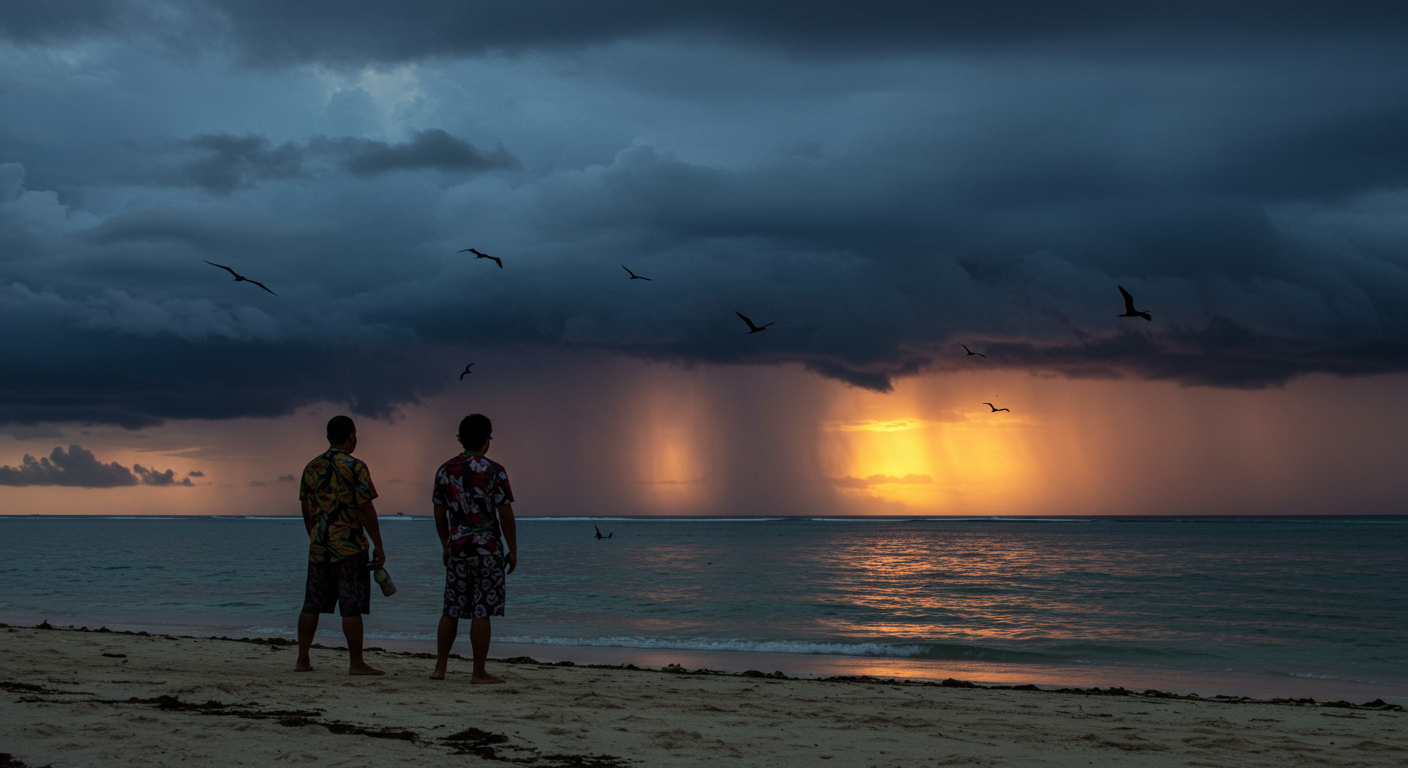
"understanding how different languages and cultures conceptualize environmental change"
The Marshall Islands offer a starting case study of this phenomenon. When climate scientists attempt to communicate about global warming and rising seas, they confront a major challenge. The Marshallese language, like many Pacific Island languages, lacks a simple way to distinguish between what English speakers call "weather" and "climate." But this isn't a limitation - it's a window into a more complex understanding of environmental change.
The key lies in the Marshallese word "mejatoto." Anthropological research has revealed that when Marshallese speakers discuss "oktak in mejatoto" (changes in mejatoto), they're describing something far broader than atmospheric conditions. Their language intrinsically connects environmental shifts with changes in human behavior, community relationships, and even perceptions of time itself.
This linguistic discovery has implications. Traditional climate change communication typically flows in one direction: from Western scientific institutions to local communities, from English to other languages, from technical terminology to simplified explanations. But this approach overlooks valuable indigenous knowledge embedded within our Pacific Island languages.
The problem extends beyond our translation work. When English terms like "climate change" and "global warming" enter Marshallese through direct borrowing, they carry different connotations than their original scientific meanings. These borrowed terms coexist with traditional ways of describing environmental change, which creates a two-headed linguistic situation where Western and indigenous understandings intermingle.
Thanks to natural language processing and other artificial intelligence disciplines, tools are increasingly being deployed to analyze climate-related documents and improve communication. However, these technologies primarily operate in major world languages and may miss the way that different cultures conceptualize environmental change. The result is a technological blind spot that mirrors a real impediment in climate science communication.
Current research points to a clear pattern: the vast majority of climate-related scientific documents are published in English, which creates an inherent bias in how environmental changes are understood and discussed globally. This dominance of English-centric research means that insights from Pacific Island languages - and our unique ways of understanding environmental change - often go unrecognized in mainstream scientific discourse.
The stakes are particularly high in the Pacific Islands, where climate change isn't a future threat but a present reality. Research shows that in societies where human activities are inseparable from atmospheric conditions - where there is less of a divide between nature and society - talking about climate independently of social changes becomes impossible. The language itself resists such artificial separation.
This resistance to separation manifests in concrete ways. While Western climate science carefully distinguishes between meteorological data and social impacts, Marshallese discussions of environmental change naturally encompass what Western observers might consider purely sociocultural phenomena. Changes in weather patterns are discussed alongside shifts in community cooperation, family relationships, and cultural practices - not because these concepts are confused, but because they are understood as inherently interconnected.
The implications for climate adaptation strategies are significant. Traditional Western approaches often separate adaptation measures into distinct categories: technological solutions, policy changes, and social programs. But in our Pacific Island context, these distinctions blur. A change in fishing practices might simultaneously be understood as an environmental adaptation, a social transformation, and a cultural shift.
Recent research has begun to question whether this holistic linguistic approach might actually offer tangible insights for climate science. The Marshallese view of climate change as a hybrid sociocultural/environmental phenomenon could provide a more comprehensive framework for understanding and addressing climate challenges. This perspective suggests that effective climate solutions must address both environmental and social dimensions simultaneously.
Emerging initiatives in climate communication are beginning to recognize this complexity. Some research projects now emphasize two-way dialogue between scientific experts and local communities, acknowledging that effective climate communication requires understanding how different languages and cultures conceptualize environmental change. These efforts highlight the importance of incorporating local knowledge systems into climate science.
One promising approach involves community radio programs that blend scientific information with local narratives and traditional knowledge. These programs create spaces where different ways of understanding climate change can coexist and inform each other. By incorporating local languages and cultural frameworks, they make climate science more relevant and actionable for local communities.
The data reveals a clear pattern: while Western climate science excels at measuring and predicting environmental changes, Pacific Island languages excel at expressing the subtle connections between environmental and social transformations. These different but complementary approaches to understanding climate change suggest the need for a fundamental shift in how climate communication should be approached.
The implications extend beyond the Pacific. As climate change accelerates globally, the need for effective cross-cultural communication becomes increasingly urgent. Yet current approaches to climate communication may be missing essential information by treating linguistic differences as barriers to be overcome rather than sources of knowledge to be understood.
To us, translators of Pacific Island languages, the challenge ahead isn't simply about finding better ways to translate Western scientific concepts into local languages. Instead, it's about recognizing that our languages might hold precious elements for understanding and adapting to our changing world. The question facing climate scientists isn't so much about whether Pacific Island languages can adequately express climate science - it's whether climate science can adequately express what Pacific Island languages already know by centuries and centuries of observation.

Huri Translations
Tel. +689 89 205 483
[email protected]
PO BOX 365 Maharepa
98728 Mo'orea
French Polynesia
N°TAHITI 876649


Social